My husband and I love experimenting with new materials, and even when we come back to crafts we’ve experimented a lot with, we do love techniques that leave room for surprise. Among all the acrylic pouring methods we’ve tried over time, the dirty pour is one we always come back to.
There’s something almost magical about it. It starts with a simple gesture: choosing a palette, stacking colors one by one into a single cup, pouring and tilting. It’s what comes after the pour that’s always different: when you begin pouring, you find yourself wondering what on earth will happen next. Once those layers are hidden inside the cup, any painting can exist, and you don’t know the one you’ll get until you can see it on canvas. It reminds me of the Schrödinger’s cat!
Dirty pours are among the easiest acrylic pouring techniques to try, but I found them among the most exciting. You don’t need complicated tools or precise movements: just paint, a cup and the willingness to be surprised. What you planned might disappear entirely, while a color you almost left out suddenly steals the show.
The result is never quite what you imagined, and that’s exactly the part we love most. No matter how carefully you plan your layers, the paint always has its own ideas. Colors slide over and under each other, sometimes disappearing almost entirely, while suddenly reappearing where you least expect them, creating unexpected shades.
That element of unpredictability is exactly why we love dirty pours so much. They invite you to let go of control, to trust the process, and to enjoy the moment when the canvas reveals what was hiding inside that cup full of color.
Here, we’d like to share some of our favorite dirty pour projects, playful experiments that remind us every time how exciting it is to let go of control and see what happens when color takes the lead. We hope we can spark your willingness to try the technique yourself.

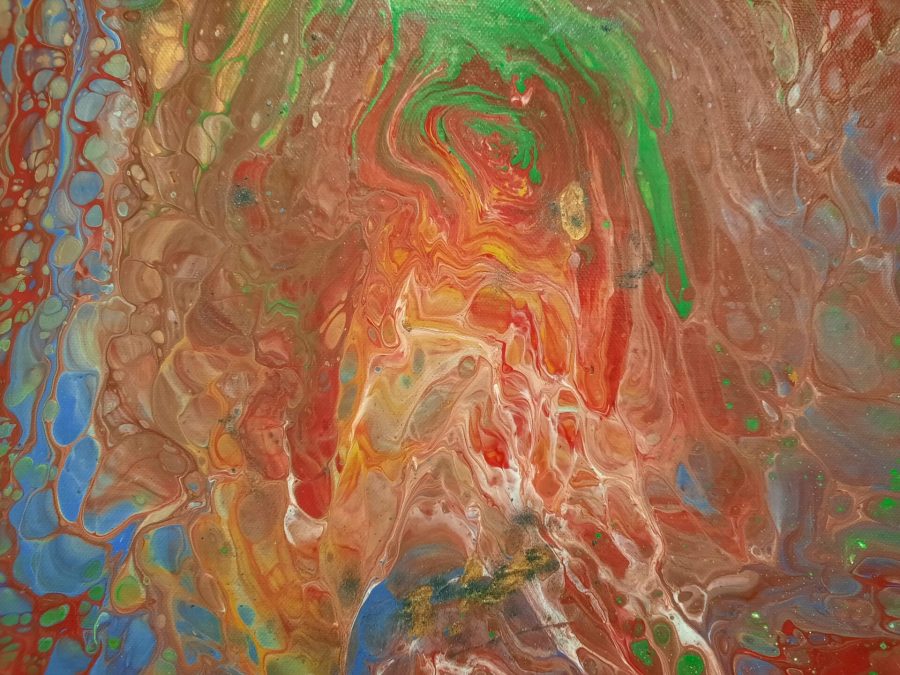


Table of contents
The first one we made
“Blue with gold” was our very first dirty pour experiment, and it’s the piece that made us fall in love with acrylic pouring.
We began simple: we stacked our colors instinctively into a single cup, added a couple of drops of silicone oil to encourage the formation of cells, and poured everything onto a black base.
Watching the colors emerge, slide and transform while tilting the canvas was mesmerizing: patterns appeared, vanished and reappeared in ever-changing ways, each more interesting than the last. In the end, the blue palette we had chosen, enriched with touches of gold, felt perfectly at home in our bedroom, elegant and full of depth.
It was our first dive into dirty pours, and a very convincing one.
The failed pour

Not every dirty pour turns out the way you imagine, and this project is proof of that.
We carefully chose our palette, stacked the colors and poured, hoping for warm reddish tones to take the lead and match our kitchen. But the paint had other plans. A bright green we had added to the mix quickly became the protagonist, no matter how much we tilted or tried to guide the flow.
It was a clear reminder of just how unpredictable acrylic pouring can be: sometimes the surprise is wonderful, sometimes it’s simply not what you wanted.
We didn’t let it discourage us, though. Simply, we reused the same canvas for another pour, rebalancing the palette and removing the green altogether. The second pour was a success, and a good lesson in knowing when to let go and start again.
"Dominant Red": the revenge of the color palette
Even though we were happy with the re-pour and re-use of our firstly failed canvas, that discarded green kept coming back to our thoughts. It wasn’t a bad color in itself, it had simply taken over the wrong painting.
So we decided to give it another chance, this time with no expectations at all. We prepared a palette not so different from the failed one, just using less green and choosing the other colors more carefully. This time, the balance shifted: red finally emerged as the dominant tone, while the green settled as a lovely contrasting accent color. The addition of a share of light blue to balance the green did indeed pay off, giving a second cold focus in this warm red base.
A subtle echo of the earlier experiment, we titled this piece “Dominant Red“.
"Fusion", with two dominant base colors
One of my favorite pieces is titled “Fusion“, because it’s the first time we ended up with two distinct dominant base colors in the same painting.
In the color stack, we intentionally added a larger quantity of light blue and light red, carefully separating them with layers of other colors. When we poured the cup in the center of the canvas,we happened to obtain a ring with light blue on the outside and red in the middle.
During the tilting, though, something unexpected happened: the blue slowly shifted to one side, the red to the other, leaving a neat division between them. As soon as we saw it, we gently encouraged the flow, and the painting became almost dual-sided.
That moment was so inspiring that it later pushed us to experiment further with two-color compositions using the funnel technique.
A double pour that well behaved: "Chocolate Passion"
This project was actually a double pour: two paintings made at the same time, with the same palette, yet ending up very different, yet perfectly complementary.
We made them for my sister-in-law, who needed something to decorate her newly refurbished room. Since she works in the chocolate industry, we chose a brown base as a small tribute to her beloved job, combined with a reddish palette to match both her favorite color and the new tones of the room.
One pour flowed symmetrically from the center, rich in cells, with brown on the outside followed by red, yellow and a very dark green that added movement and depth. The other developed in a more linear, oblique way, with more flowing areas, fewer cells, and a clearer separation between brown and red thanks to strikes of yellow.
Different in character, yet clearly related, the two paintings found their place together on her wall behind the working station: a double pour that behaved exactly as we had hoped.
And this is not the end!
This was just a small selection of our main dirty pour projects. Over time we’ve made many more, and for sure we’ll make others. They were not just for ourselves, but also for friends and family, even for our office spaces. Each one brought its own surprises, lessons and small moments of wonder.
Dirty pours were only the beginning, though. Along the way we experimented with other acrylic pouring techniques as well, discovering just how different the same colors can behave depending on how they’re poured. The funnel technique, in particular, turned out to be incredibly satisfying and has become my personal favorite.
Now we’d like to hear from you. Have you ever tried acrylic pouring? Do you have a technique you keep coming back to, or one that surprised you the most? And if you’ve faced a “failed” pour like we did, how did you handle it? Did you start over, reuse the canvas or turn it into something new?
Share your experiences in the comments below. Confronting ideas, successes, even mistakes with other crafters is one of the best ways to inspire each other and help our creative community grow together.