
Find out:
- Model
- Production year and factory
- Manuals and spare parts lists
- Decals and decoration sets
About this database:
- 510.348.331 total serial numbers
- Production records from 1850 to 1971
- 2.603 documented surviving machines
ⓘ What is a Documented Machine?
ⓘ Where do I find the serial number?
This database was created to make identifying vintage Singer sewing machines easier and more reliable. Instead of manually scanning long PDF tables, you simply type your letter prefix and digits to automatically pull up the model, year, factory and even manuals. It combines Singer’s historical production records as published by the company in 2005 (available in the Resources section below), with information from trusted references such as ISMACS, books by expert authors, historical research and other reliable sources. We continuously review and expand the database to make it as accurate and complete as possible.
We took this a step further, though: we connected preserved historical records to real surviving machines. That’s what “documented machines” means. Whenever we examine a surviving Singer sewing machine, we add its details to the database. This links a specific serial number to a real machine, allowing us to confirm information such as its model, decals and other features. These verified records help us cross-reference models, decals, factories and production years, improving the accuracy of the database and preserving information when the original factory records are incomplete or have been lost. Documented machines have already helped identify inconsistencies in historical records. For example, a surviving Singer 327K with serial EX042226 showed that a batch listed as 328K also contained 327K machines. And it’s just one of many cases.
Historical serial number records are an invaluable starting point, but they are not always complete. Serial number allocations tell us about production ranges and factory records; verified surviving machines allow us to compare those records with real examples and discover details that original records do not preserve. If you notice anything that doesn’t look right, or have additional information that could help improve the database, please leave a comment or get in touch.
If you’re looking to learn more about Singer serial numbers keep reading below and visit our other informational resources. You’ll learn where to find serial numbers, what do they look like, how they work, the difference between a model and a class, the peculiarities of the main Singer factories, the different decorations applied to machines and other historical information.
Table of contents
About Singer sewing machines serial numbers
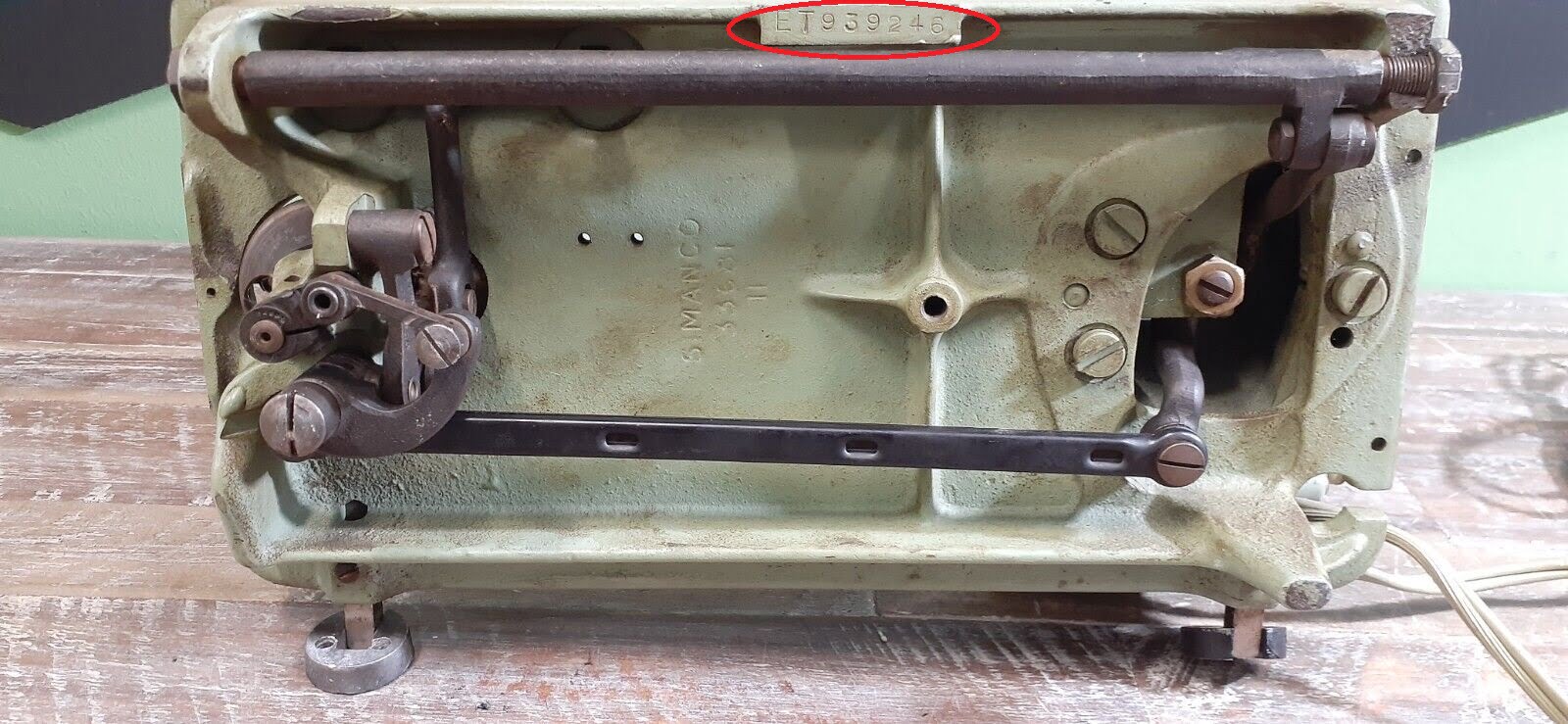
Where to find the serial number
When you look at a vintage Singer sewing machine, you may notice a series of numbers stamped or engraved somewhere on its body. Singer has always marked its machines with serial numbers, ever since the beginning of their production.
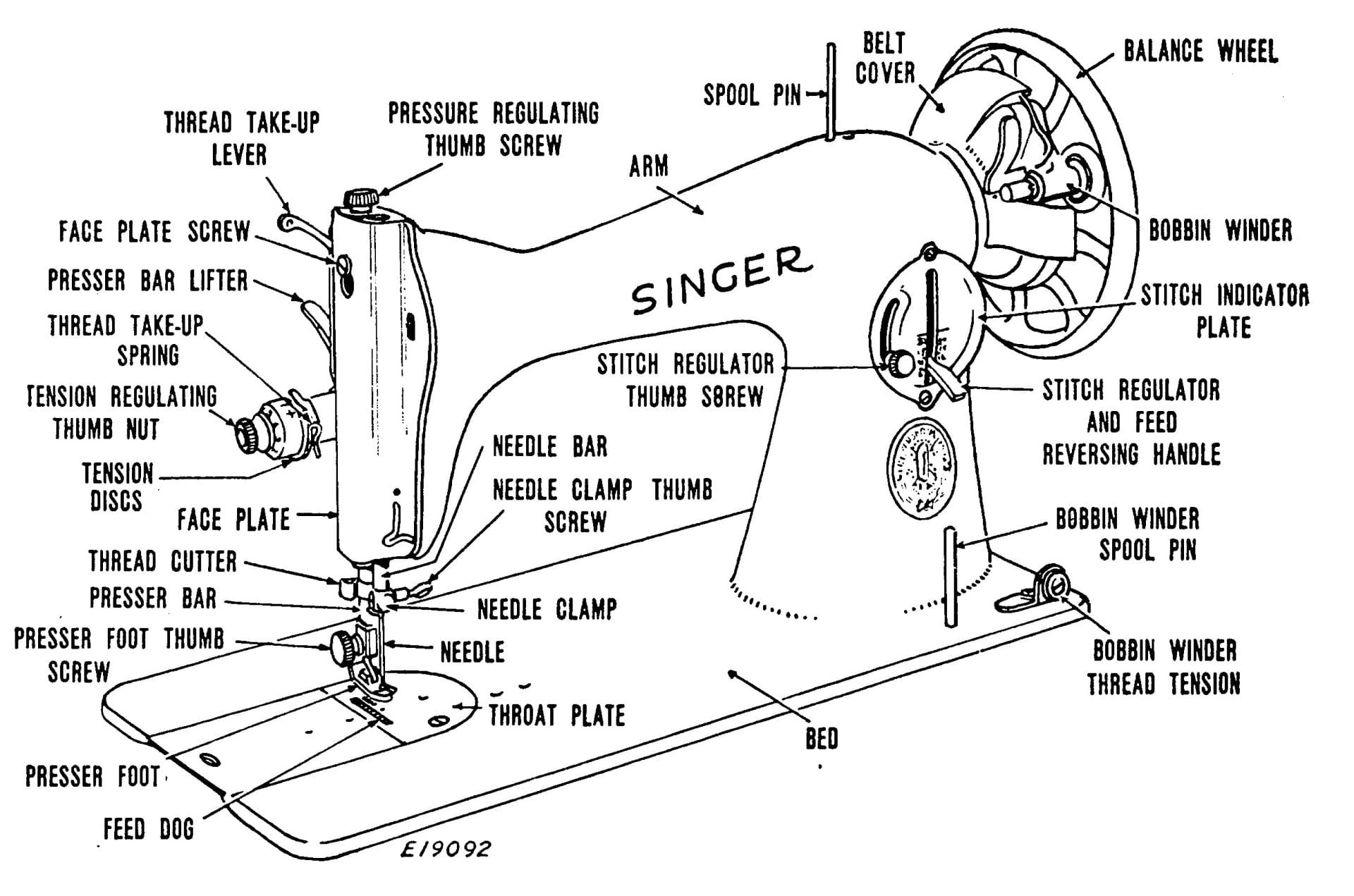
First things first: where can you find the serial number on your Singer sewing machine? Depending on the model and age of your machine, the serial number can be located in various places.
Common locations include:
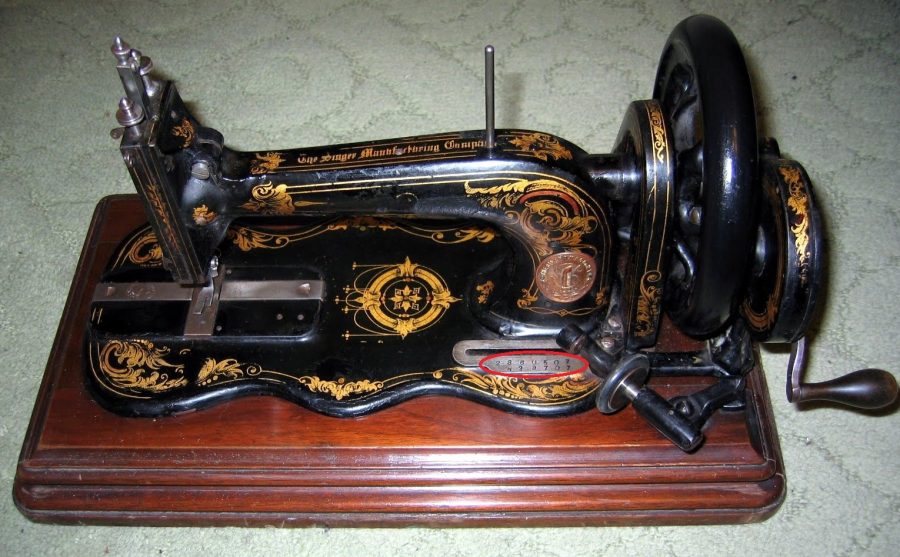
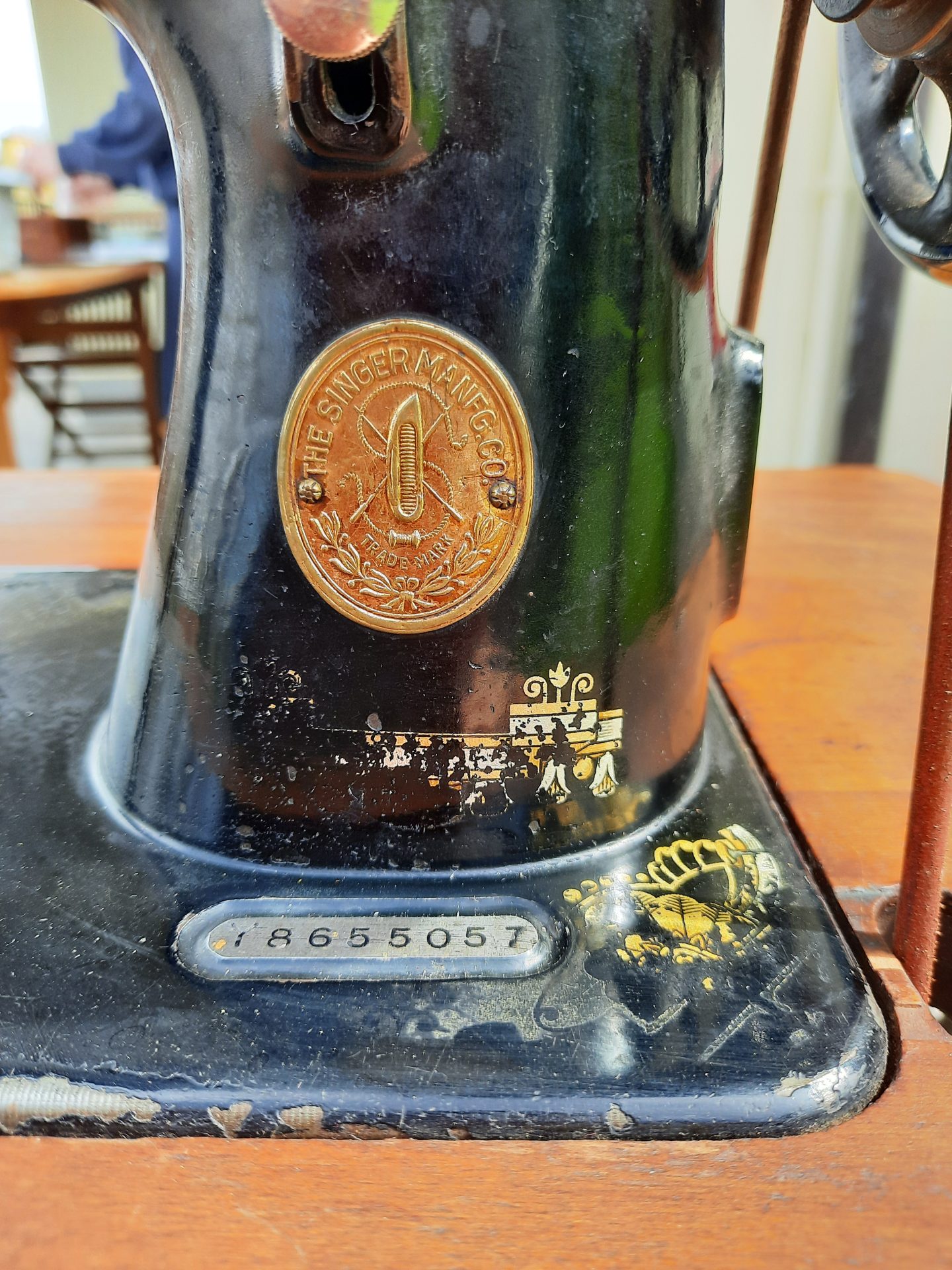
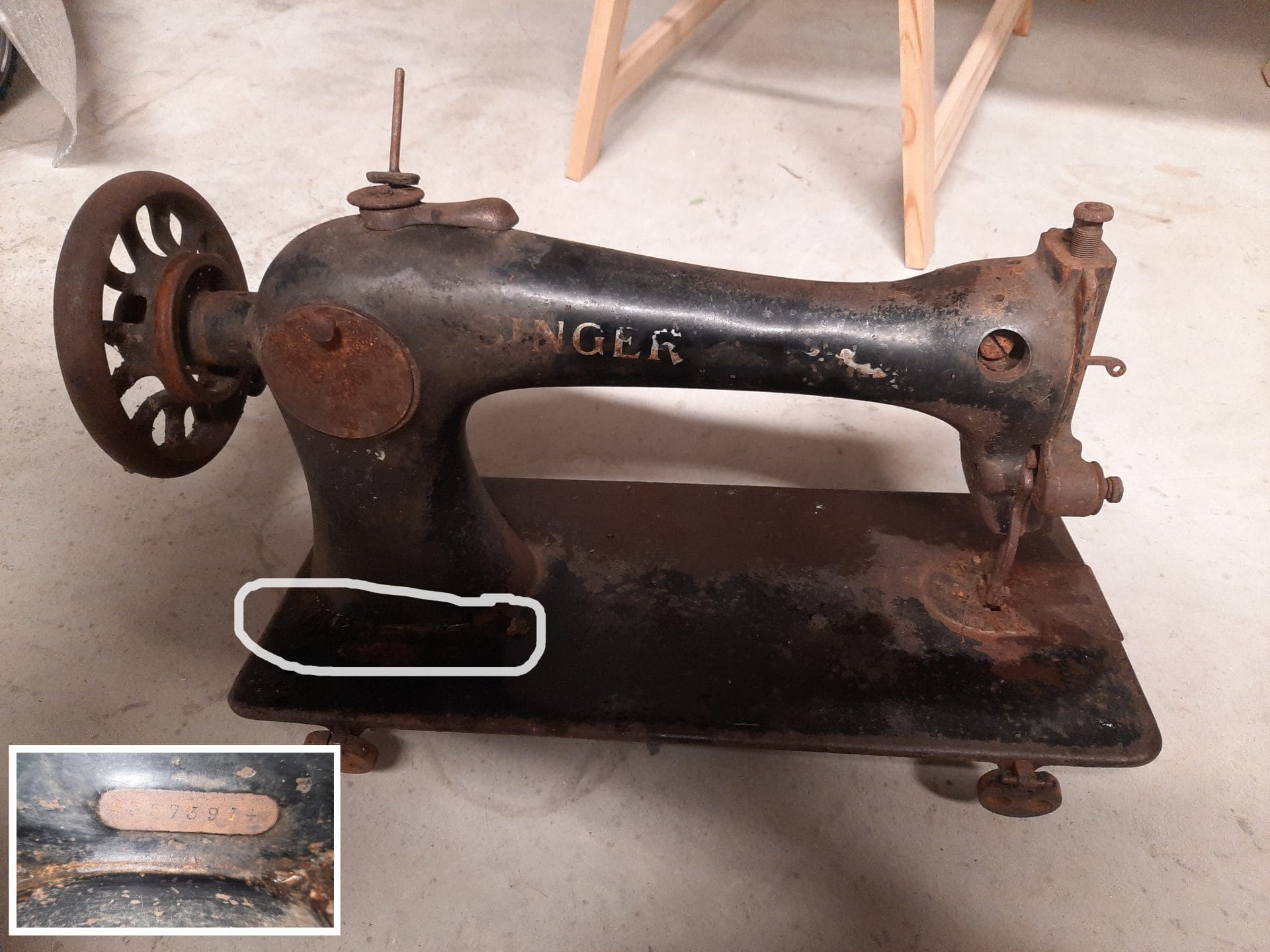
- On top of the bed. This is the most common place, and the easier to spot, usually near the main machine body on the wheel side, not far from a golden Singer logo. Look for an engraved metal plaque applied to the base of the machine. For machines made before the 1950s, the serial number is often located on top of the bed at the front right corner. Earlier models may instead have the serial number plate at the back right corner, and you read them upside down if you go to the back of the machine. Machines made between 1855 and 1889 may have two serial numbers: the primary one, used for dating and identification, is the biggest one of the two.
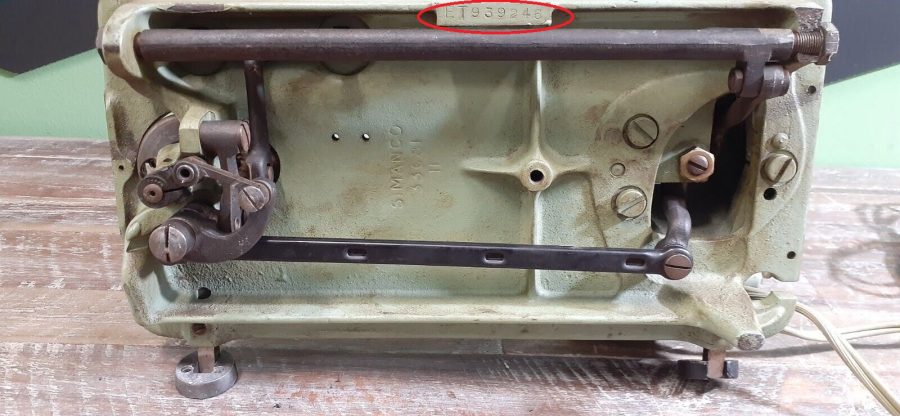
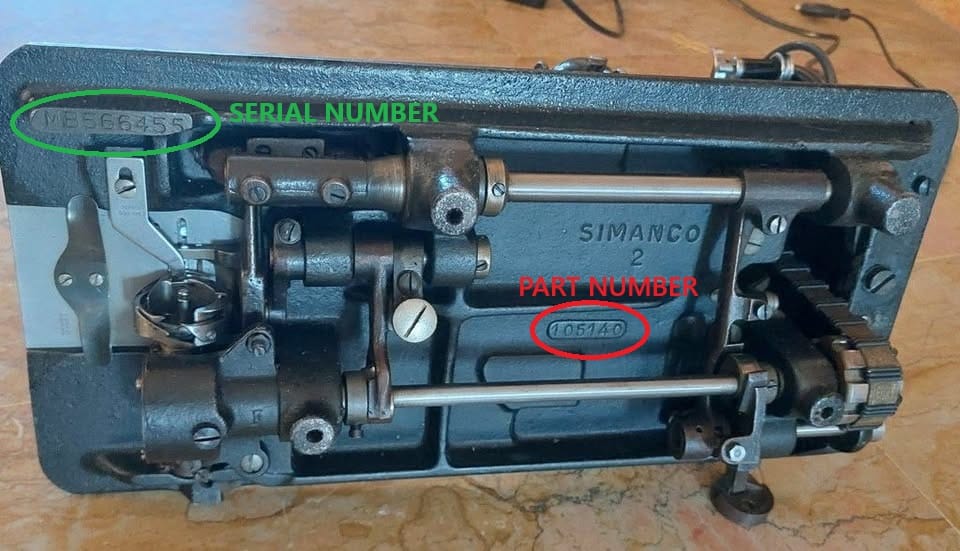
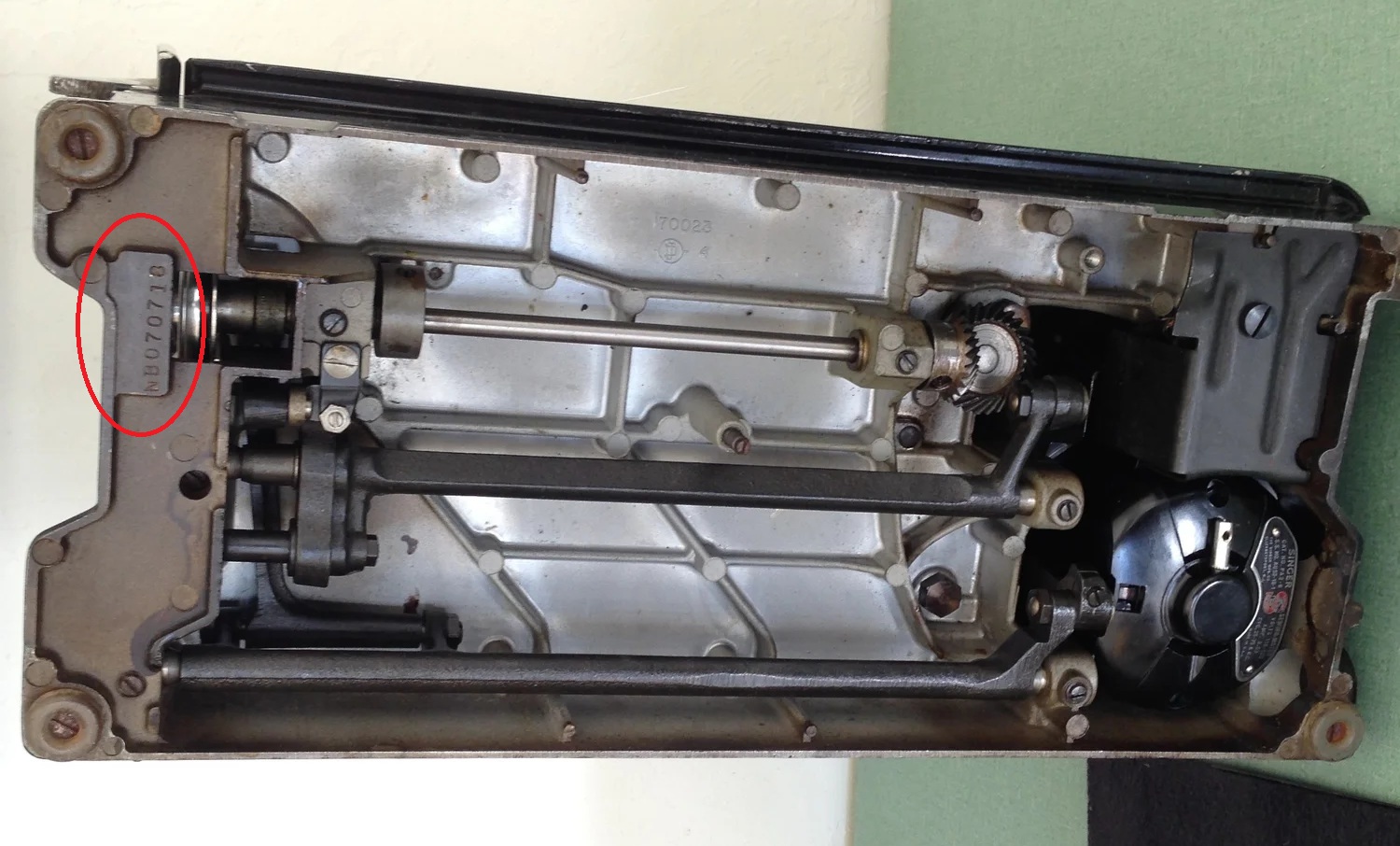
- Underneath the machine. If you don’t see numbers on the base of the machine, try on the bottom. A serial number pad may be accessed by tilting or removing the machine from its treadle or wooden box and checking underneath. Inspect the bottom edge of the bed and look for raised metal pads or flat engraved areas. When looking for a serial number under the machine, always check around the edge: you may find the serial on a center pad, or on one of the corners. Be careful, it’s easily confused with part numbers when letters are the same size, though part numbers usually are not on a raised pad, but engraved directly on the piece itself.
- Near the bobbin area. Some older machines have the serial number stamped on the throat plate (the metal plate covering the bobbin area) or underneath the metal slide plates under the needle.
- Less visible areas. Some models may have the serial in hard-to-spot places underneath the bed. Again, look for a raised metal pad. In some cases, for example for the Featherweight, serial numbers can be found on the bottom, next to the bottom tray, but a few of the early AD-series machines are found inside and underneath the bottom tray. Slant-needle models like the 301A or 401A have their serial on the underside edge of the machine deck lip (usually toward the left or center, under the bed), stamped into the metal.
When searching for the serial number, it’s important to inspect these areas carefully, as the numbers may be faint or obscured by dirt and grime. Take a close look under good lighting conditions. Also frottage may help: try rubbing a pencil over paper placed on the engraved numbers, sometimes with this trick you might reveal hard-to-spot digits.
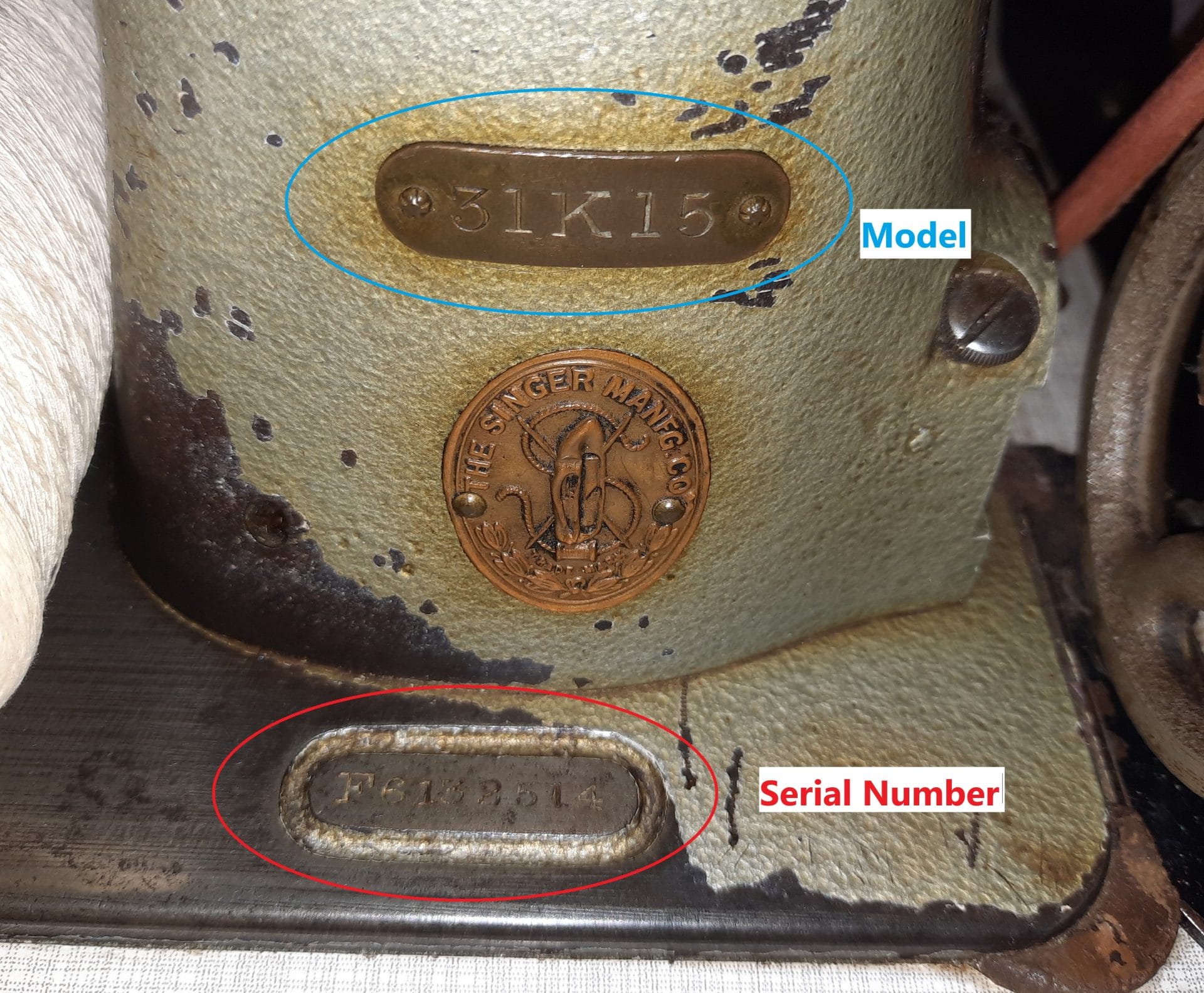
Also, knowing the format of the serial number helps a lot when the identification is not easy due to bad preservation of the machine. Be wary that some machines may also have the model number stamped on, usually on a small raised plaque on the main body of the machine, right in front of the sewist, in the most prominent place above the Singer logo. Learning how to distinguish model from serial is even more important in such cases.




Support our work!
Enjoy this website?
Please consider a small tip to say thanks.
(No account required!)
What can you learn from the serial number?
Just at the first glance, the serial number itself can give you valuable information.
If the serial number consists only of numbers, it suggests that the machine was manufactured before 1900. These serial numbers typically follow a simple sequential numbering system, with each machine assigned a unique number. It’s important to note that for Singer sewing machines manufactured before 1900, there are no factual records available. Instead, estimates of production years are made based on ranges of serial numbers. While these estimates are generally regarded as fairly accurate, they are not definitive records.
From 1855 to 1889, most Singer sewing machines carried two numbers adjacent to each other, with the larger of these numbers considered the relevant serial number. In 1889, Singer dropped the use of two serials. For machines produced in this period, you can also happen to find a single serial number.
About the factory, between 1870 and 1900 all machines were made at either the Elizabethport or Kilbowie factories. It’s likely that a system of issuing blocks of numbers to each factory was used to manage serial number allocation. However, there is no breakdown available indicating which numbers were allocated to each factory.
If the serial number starts with one or two letters followed by numbers, it indicates that the machine was manufactured after 1900. These letters often represent the factory location.
These letters were used for pre-production planning purposes, where large batches of numbers were pre-allocated to ensure sufficient materials and parts were ordered in advance. The serial numbers themselves were not used on machines until months or even years after these allocation dates, and sometimes they may not have been used at all. Due to changes in order situations and unforeseen circumstances, errors in serial number records are common.
This is why in serial number records you can find online, even in our database, you find an “allocation date“: on that specific date, following the information we have from historical sources, a certain batch of serial numbers (from X to Y) where “allocated” to those to-be-produced machines of that particular model in that specific factory.
While pre-allocating serial numbers for pre-production planning purposes was a common practice, the order situation could indeed change before actual manufacturing took place. As a result, there were instances where serial numbers allocated for one model were eventually used on different models than originally anticipated.
This variability underscores the importance of caution when attempting to determine a Singer sewing machine’s model solely from its serial number. While the serial number can provide valuable information about the machine’s production timeline, it’s essential to cross-reference this data with other identifying features to confirm the model accurately.
Why do some Singer machines have two serial numbers?
On early Singer sewing machines, produced from 1856 to 1889, you might find two serial numbers. Singer used a primary “Register Number”, which we now refer to as the main serial number, to track all machines produced across its factories. Alongside this, some machines also have a smaller “Factory Number”, that was unique to a model or class at a particular factory. This secondary number sometimes reflected a running count from a specific batch.
In the USA, the Factory Number was generally 4000 less than the Register Number until around 1867, when the company began using it as a cumulative count for each model. In Scotland, Singer’s Glasgow factory used Factory Numbers to keep disassembled machines organized, ensuring matching parts stayed together during finishing and reassembly. This practice continued until Singer transitioned to interchangeable parts in the early 1890s.
The beginning of this practice of using two serial numbers is usually linked to the “Albany Agreement” of October 24th, 1856, which started the Sewing Machine Combination, the first US patent pool. This agreement came at the end of what’s called the “Sewing Machine War”, a period of licensing and litigations over the patents for the lock stitch sewing machine invented by Elias Owe and others of the same author.
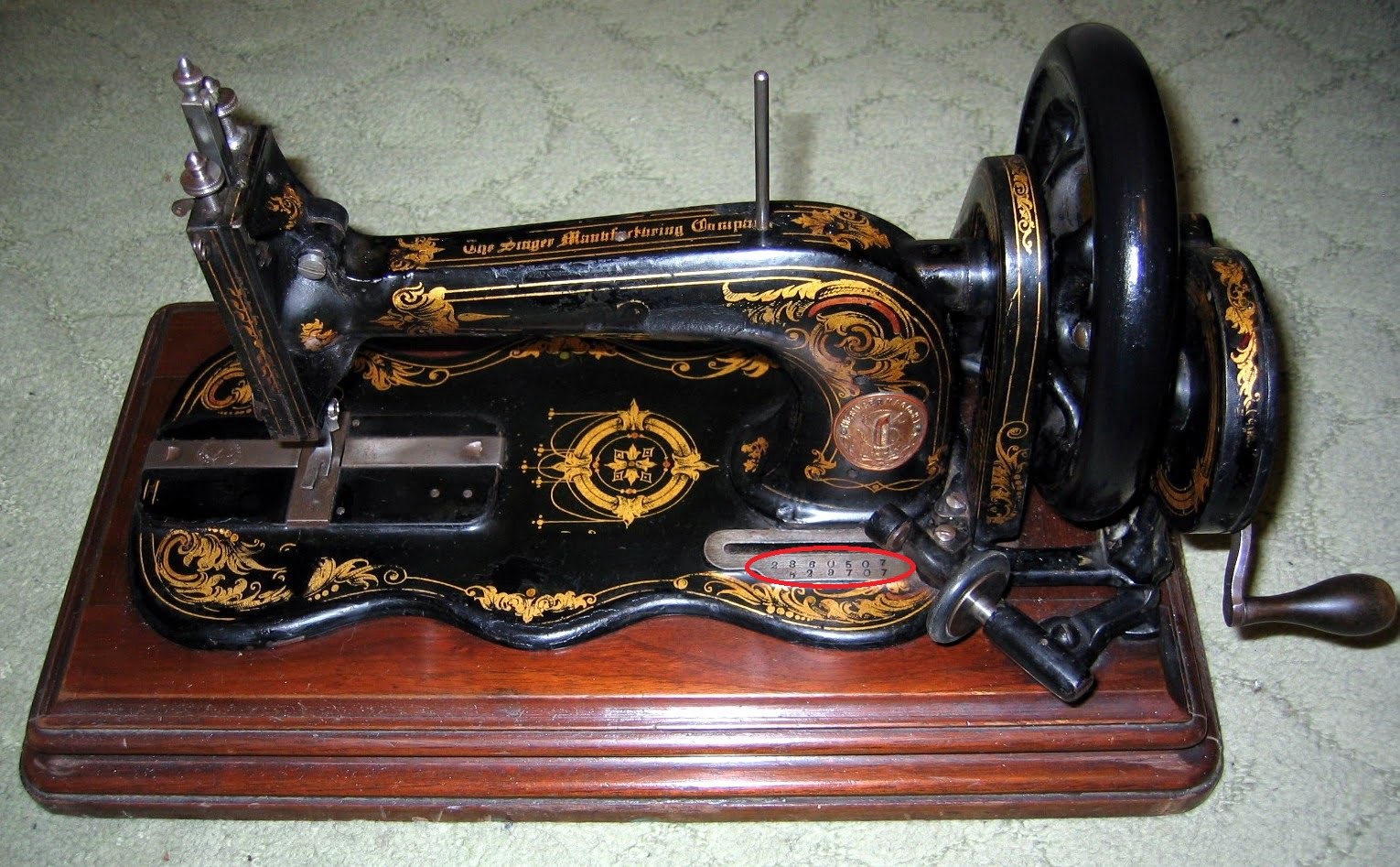
The exact purpose of this double numbering system remains partly a mystery. While the Factory Number may have been useful for tracking parts and models, it’s unclear why Singer maintained both numbers for so long, or why American and Scottish factories followed slightly different numbering practices. Starting with the Improved Family model in 1879, Singer assigned only a single serial number to new models, and by 1889, midway through a batch of 12K machines, it fully discontinued the two-number system.
The serial number format
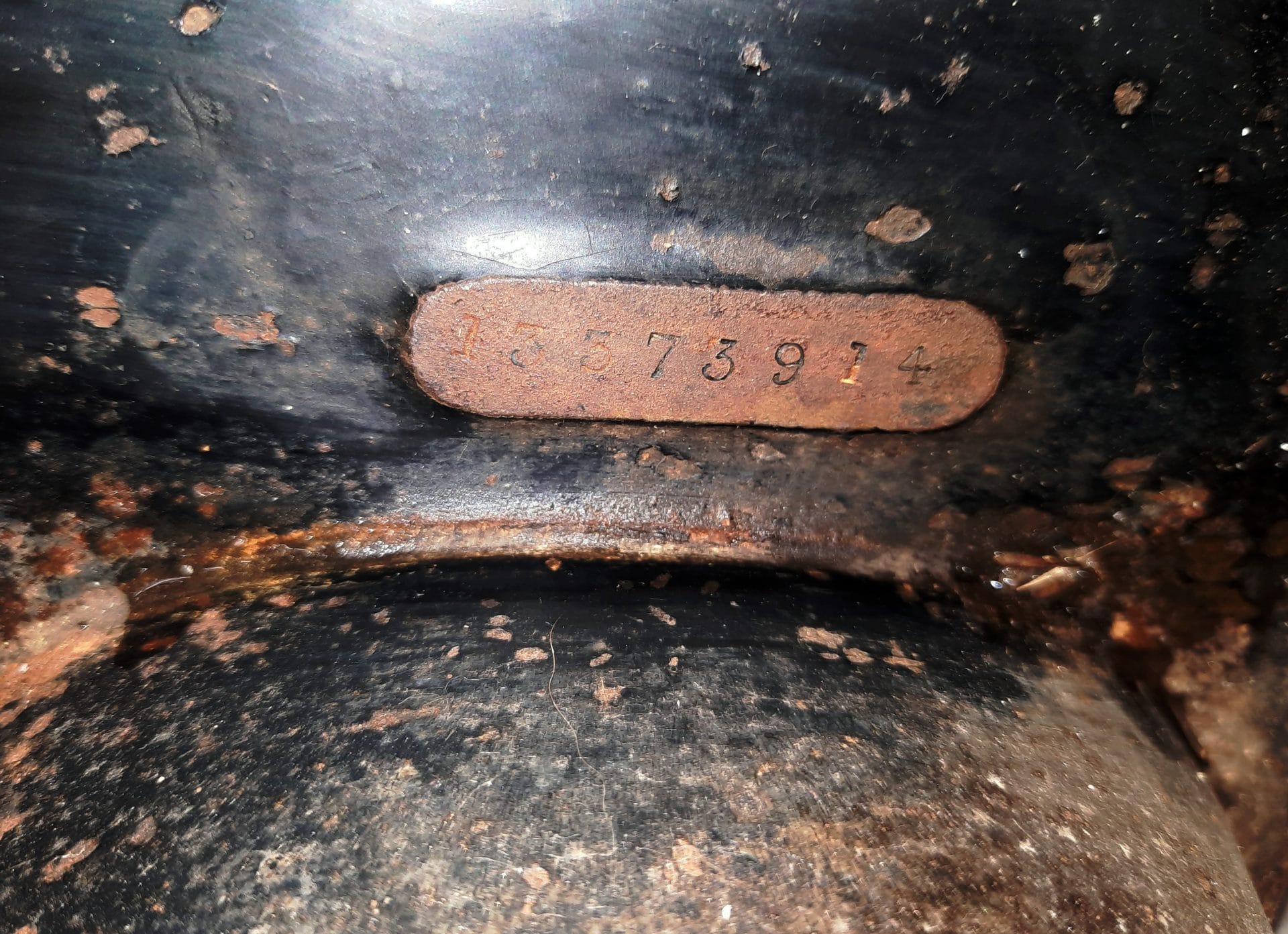
Let’s sum up the possible serial number formats:
- Only numbers (up to 8 digits), for machines manufactured up to 1899.
- For example, a machine with the serial 611.000 was manufactured in 1871. Records from that year are the older ones preserved, no official Singer company source before that year has been preserved. Instead, a machine with the serial 16.831.099 was manufactured in 1899. Following the official Singer records we have, after this serial number the format changed to receive prefix letters.
- A number preceded by one letter, for machines manufactured from 1900 onwards. The letter may give information about the factory.
- For example, a machine with the serial number K88001 was manufactured in 1902 in Elizabethport, New Jersey (USA), according to the official Singer records for the K-series serial numbers.
- To be precise, 1902 is the allocation year: it means that in 1902, 18th February, the factory allocated one thousand serial numbers to be assigned to a batch of class 18 machines. All those one thousand numbers may not actually have been assigned, the factory might have assigned some or all of them to another class entirely, and may even have used them in a following year. Yet, the allocation data is the most accurate way to estimate the production year of a Singer sewing machine.
- About the letter, each different one was assigned to one factory: the main production plants had more than one letter prefix associated, the smaller ones had one letter prefix. The official Singer records did a good job in keeping an accurate list of the association between letter prefix and factory, you can find them linked in the Resources below.
- A number preceded by two letters, for machines manufactured from 1900 onwards. As the Singer company opened more and more factories, and produced millions of machines a year, more identification letters were needed, so they started using two-letter prefixes.
- For example, a machine with serial number EA173846 was manufactured in 1935 in Kilbowie, Clydebank (Scotland). The serial number was allocated in December 1935 to a batch of 66K-class machines, as per the official records.
- When two letters are present, it’s the couple that’s associated with the factory. The Clydebank factory, for example, one of the main Singer factories, has several prefix letters associated, both single and double letters.
A warning when reading the serial number if it’s not clear, due to rust or dirt or because ruined by the passing of time. To avoid mistaking a letter for a number or viceversa, Singer never used the letters O or Q, at the beginning also I was avoided. To avoid confusion between the letters V and U, only V was ever used between the two.
While looking for the serial number on the machine, pay attention to small plates with short numbers: they may be the plate with the class/model number.
You can find the official Singer records that have been preserved, as published by the company itself, in the Resources section below.
Class and model numbers
When browsing a manual or finding Singer machines for sale, you could find the model stated in more than a single straightforward way.
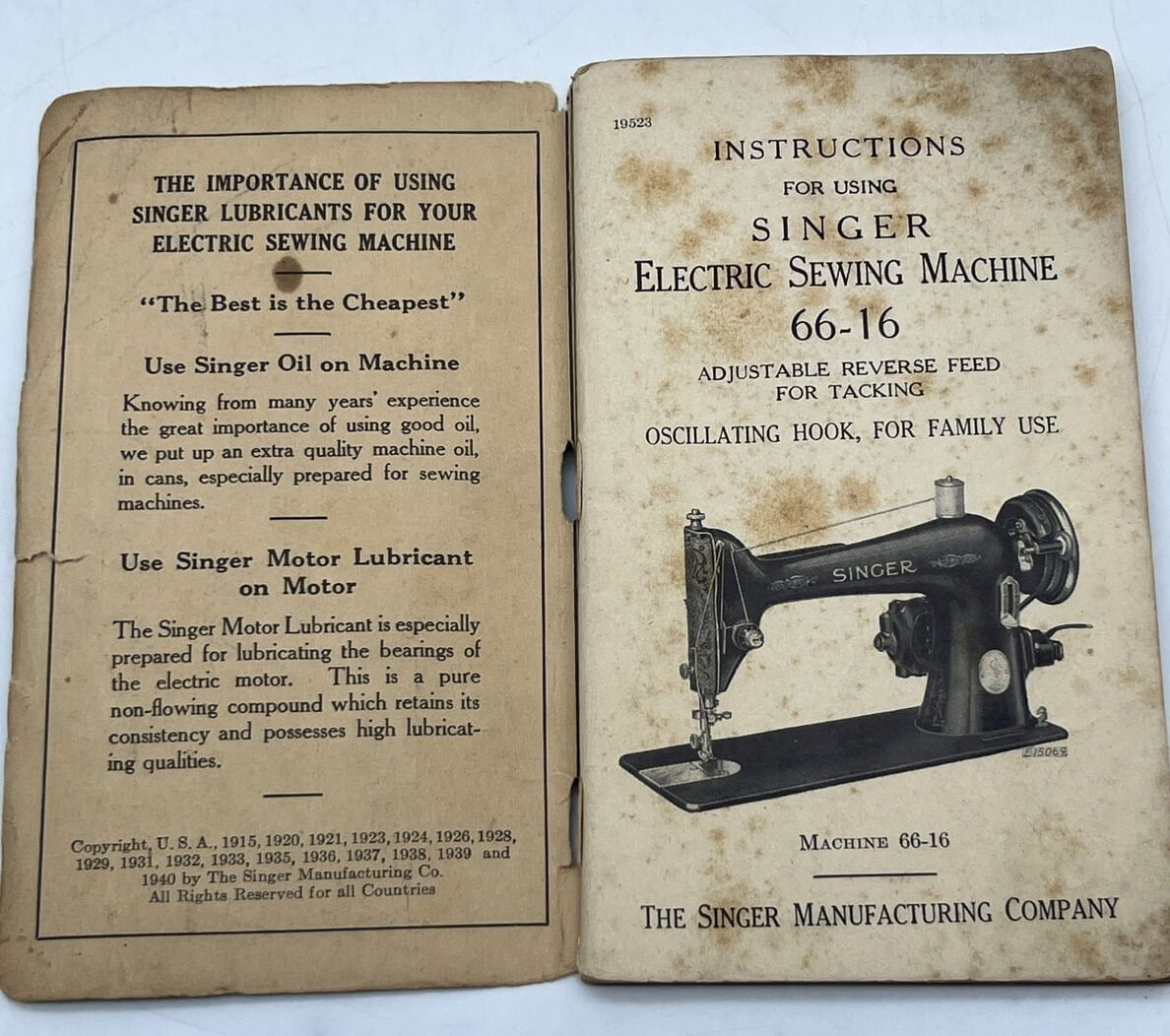
The first part of the model number, such as “15” in the example “15K80,” represents the class number. This indicates the basic design of the mechanism.
The second part of the model number, represented by a letter like “K” in “15K80,” is a location code for the factory where the machine was made. For example, “K” stands for Kilbowie in Scotland. Other location codes include “M” for Monza in Italy, “B” for Bonnieres in France, and so on. Elizabethport in New Jersey, the first big Singer factory, used a hyphen symbol “-” instead of a letter. The use of a hyphen symbol could also indicate that no location is specified for that machine class.
The final part of the model number, such as “80” in “15K80,” is a variant number (sometimes referred to as “sub-version”), used to indicate optional features and changes over time. Machines of the same variant are identical, regardless of where they were made. However, machines with different variant number may have some different parts, even if they were made in the same factory.
It’s important to note that full model numbers could be abbreviated, to either just the class number or the class plus location code.
Support our work!
Enjoy this website?
Please consider a small tip to say thanks.
(No account required!)
Special varieties
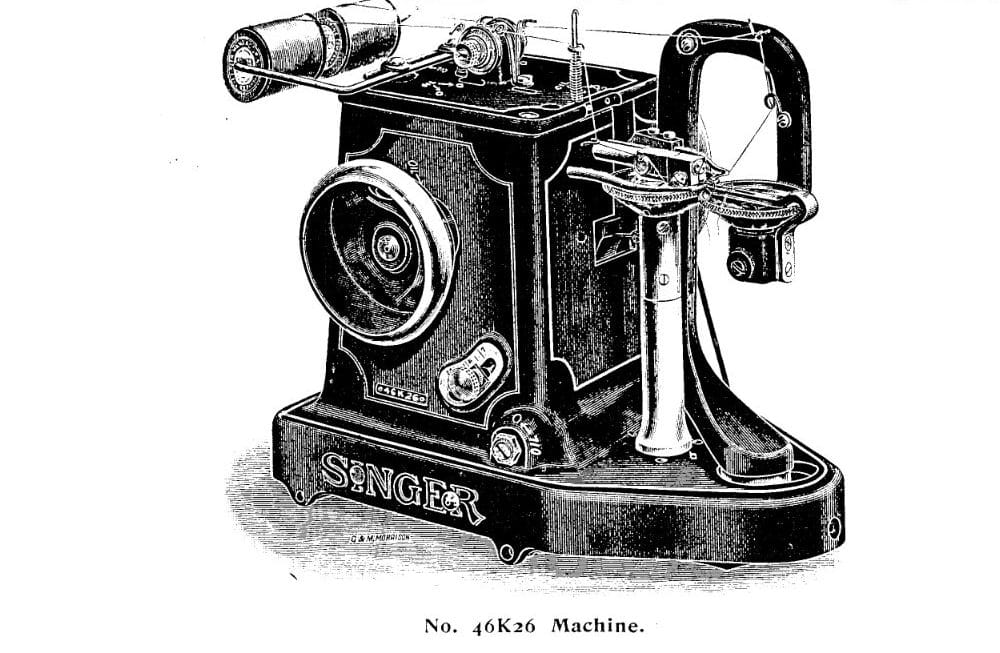
You might come across a model number where the location code consists of two or three letters, such as 16KSV3 or 45SV58.
The letters SV stand for “Special Variety”. Singer produced an impressive range of machines, tailored to countless specialized tasks. Some industrial sewing machines were designed for highly specific purposes: for example, the model 32-64 for serging and attaching binding to carpets, or the model 46K27 for sewing gloves and furs, or the model 92-20 for sewing bags, or the model 157-4 specific for medium burlap bags…
However, certain industries sometimes required even more specialized modifications. In such cases, they reached out to Singer, and the company created Special Variety models, adapting existing machines to meet unique needs.
List of factory location codes
The extant official Singer records (linked in the Resources section below) include information about the factory where each machine was manufactured, as well as the location code assigned to that factory. For your convenience, I’ve compiled a list of factories and their corresponding location codes. Additionally, I’ve included factories for which we have records of serial numbers, but no assigned location codes.
Most major factories were given a location code, a letter appended to the class number to indicate the manufacturing site of a particular machine. Smaller factories often lacked unique location codes, as they primarily assembled parts produced in larger facilities like Elizabethport and Kilbowie. However, some smaller or newer factories did produce complete machines in-house.
It’s important to note that location codes are found in the model number and are distinct from the prefix letters in the serial numbers.
| Factory | Location code |
|---|---|
| Anderson, South Carolina (USA) | A |
| Bogota (Colombia) | L |
| Bonnières-sur-Seine (France) | B |
| Bridgeport, Connecticut (USA) | W |
| Buenos Aires (Argentina) | |
| Campinas (Brazil) | C |
| Elizabethport, New Jersey (USA) | - |
| Istanbul (Turkey) | |
| Karachi (Pakistan) | |
| Karlsruhe (Germany) | G |
| Kilbowie, Clydebank (Scotland, UK) | K |
| Lima (Peru) | |
| Montreal (Canada) | |
| Monza (Italy) | M |
| Penrith, NSW (Australia) | P |
| Podolsk (Russia) | |
| Querétaro (Mexico) | R |
| Santiago (Chile) | |
| St. John's Factory, Quebec (Canada) | J |
| Taichung (Taiwan) | |
| Taytay (Philippines) | |
| Utsunomiya (Japan) | U |
| Wittenberge, Prussia (Germany) | D |

Factories
Initially, Singer’s sewing machines were produced in a small shop in Boston. As demand for sewing machines grew, Singer expanded production and established its first factory.
By 1860, Singer had become one of the largest sewing machine manufacturers in the world. To meet increasing demand, the company opened additional factories in the United States and abroad. In 1863 Singer moved to New York, and by 1872 it established a large factory in Elizabethport, New Jersey. This factory became one of the company’s primary manufacturing facilities and played a significant role in Singer’s expansion.
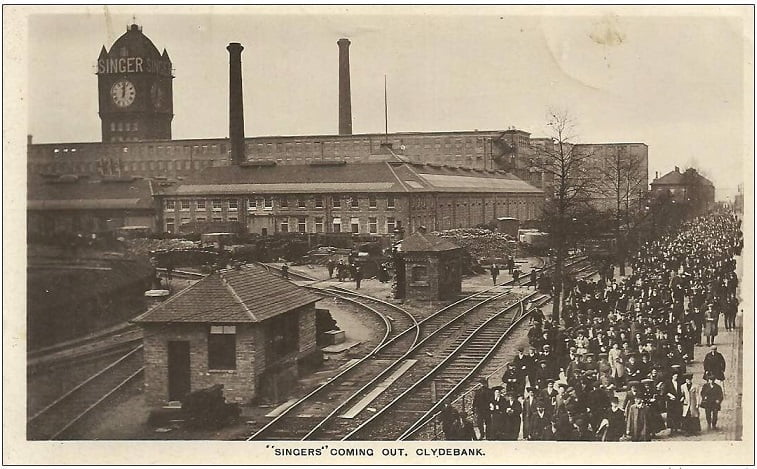
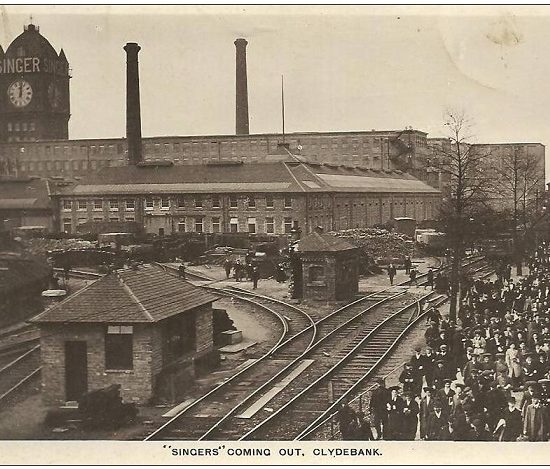
This factory, though, was also quickly outgrown, and after a temporary move to an intermediate site, a new factory was built on a 46 acre site in Kilbowie, Clydebank (Scotland). This factory, situated on the banks of the River Clyde, became one of the largest sewing machine factories in the world. It produced millions of sewing machines for both domestic and industrial use and played a crucial role in Singer’s global operations. Together with the Elizabethport factory, these two sites were the backbone of the Singer empire.
In addition to its factories in the United States and Scotland, Singer established manufacturing facilities in other countries, including Canada, Italy, France, and Germany. These factories produced sewing machines tailored to local markets and helped solidify Singer’s position as a leading global brand. Some of the smaller factories could make complete machines, but others more often just assembled the parts that were sent from the two main factories in Elizabethport and Kilbowie.
Many factories were allocated “Location Codes”, which appeared in model numbers to identify where the machines were made. They are not to be confused with the initial letters of serial codes, though.
At the beginning of the 20th century, Singer began adding letter prefixes to its serial numbers, each different letter allocated to one of the factories, the bigger ones having more than one letter prefix associated.
While many records were lost, mainly for the smaller factories, the registers for the Elizabethport and Kilbowie factory and more others were preserved. For some years, the PDF versions of those records were even publicly available on the official Singer website.

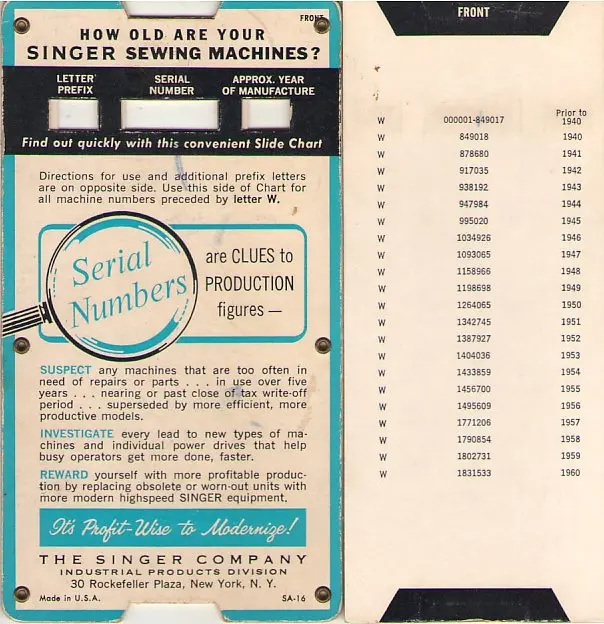
List of prefix letters with their associated factory
Following the official Singer records for one-letter and two-letter prefix serial numbers (that you can find in the Resources below), I compiled a list of prefix letters with their associated factories. I also wrote down a list of factories with corresponding prefixes.
Please note that those are not the location codes you find in the model number.
Factories with their associated prefix letters
| Factory | Serial prefix letters |
|---|---|
| Anderson, South Carolina (USA) | NA to NC |
| Bogota (Colombia) | CA to CY |
| Bonnières-sur-Seine (France) | SA to SN |
| Bridgeport, Connecticut (USA) | W |
| Buenos Aires (Argentina) | KA to KY |
| Campinas (Brazil) | RA to RY |
| Elizabethport, New Jersey (USA) | B, D, G, H, K, L, N AA to AT, BA to BY |
| Istanbul (Turkey) | HA to HY |
| Karachi (Pakistan) | DA to DY |
| Karlsruhe (Germany) | PA to PY |
| Kilbowie, Clydebank (Scotland, UK) | F, M, P, R, S, V, X, Y FA to FY GA to GY EA to EY |
| Lima (Peru) | SP to SY |
| Monza (Italy) | MA to MY |
| Penrith, NSW (Australia) | VA to VY |
| Podolsk (Russia) | A, E, T, S* |
| Querétaro (Mexico) | YA to YY |
| Santiago (Chile) | WA to WY |
| St. John's Factory, Quebec (Canada) | JA to JE |
| Taichung (Taiwan) | ND to NY |
| Taytay (Philippines) | LA to LY |
| Utsunomiya (Japan) | TA to TY |
| Wittenberge, Prussia (Germany) | C |
Prefix letters with associated factories

Explore Singer decoration sets
Browse the list of the most common Singer decoration sets, both decals and hand ornamentation. Read more about patented designs and Isaac Merrit Singer writing about the decoration department in his factories in 1884.
Decorations: about decals and hand ornamentation
Singer sewing machines have long been known for their intricate and often complex decorations. Many sets repeat from machine to machine, and those were applied using decals. The names we use today to identify them were not officially given by Singer: they have been used by collectors for such a long time, that they began to stick. Famous is the iconic “Red Eye”, officially known in Singer factories as “Scroll (red)”.
Initially, Singer machines were hand-ornamented, with designs to be followed, even patented ones. The shift to using decals is not well-documented. Examples show machines from the mid-1880s that were still hand-ornamented, while others of the same years already carried decals. It’s unclear whether the transition to decals was gradual, simultaneous, or factory-dependent.
To help make sense of it all, I’ve created a page showcasing the most common decals and hand ornamentations. By collecting data from hundreds of documented machines, I aim to pinpoint when and where specific decals were used, and by which factories. I hope this will help narrow down the production period of machines for which factory records are lost.
This ongoing research is a community effort. If anyone would like to contribute with data and maybe a photo of their machine, it would be highly appreciated. You can send your data via our suggestion form, with a comment down below or writing us an email.
The more data we gather, the better we can understand these decorations and their place in Singer’s history. Your help is invaluable in making this research even more accurate and useful for the community.
Finding a manual
Once you’ve identified your machine’s class or model, you’ll need a manual to learn how to operate it correctly. Be sure to double-check your model number: relying solely on the information available through the serial number may not be enough. I’ll never stress this enough: serial number records reflect Singer’s original manufacturing plans, not necessarily what was ultimately produced.
Singer allocated batches of serial numbers to specific models, factories and production runs. However, various factors could lead to a machine receiving a serial number originally intended for a different model. Factory needs could shift, and historical records – some of which are quite old – may contain errors.
While a serial number can offer clues about a machine’s date and model, it’s only a starting point. The best way to verify your machine’s model is by comparing it to others through photos and/or consulting experts. Forums like Victorian Sweatshop Forum or Facebook groups like Old School Singer Sewing Machines are invaluable resources, gathering knowledgeable and helpful people.
As for where to find a manual, you can search for an original copy for sale on Ebay or similar marketplaces, or use one of the many digital versions available online. Many Singer manuals have been digitized, either individually or compiled into lists.
To make things easier, I’ve gathered links to all the Singer sewing machine manuals I could find online in one place. You can browse the list and filter by class to narrow down your search to your specific model. You’ll find user manuals, service manuals, and even parts lists. Some popular classes even have manuals available in multiple languages.
Find your Singer sewing machine manual
Browse our list of digital Singer manuals: you can filter by class and/or language to help you find exactly what you need.
Determining the value of a vintage Singer sewing machine
Determining the value of a vintage Singer sewing machine can be challenging due to the many factors that influence each machine’s value.
Although Singer was one of the most widely distributed sewing machine brands worldwide, the appeal and price of each machine depend greatly on its rarity, condition, and location. The very same machine could be highly looked for in a country, but not in another. Collectors often need to weigh these factors carefully, as even commonly found Singer models may have specific features or variations that add significant value.
Support our work!
Enjoy this website?
Please consider a small tip to say thanks.
(No account required!)
The rarity of a vintage sewing machine can greatly influence its value, yet determining rarity isn’t always straightforward. Some models were produced in limited runs or had unique features, making them highly sought after among collectors. However, not all rare models are equally valuable, as demand often varies by region or collector preferences. For example, certain machines with specific decals or production variations may be common in one area, but almost impossible to find in another, creating regional “rarities”.
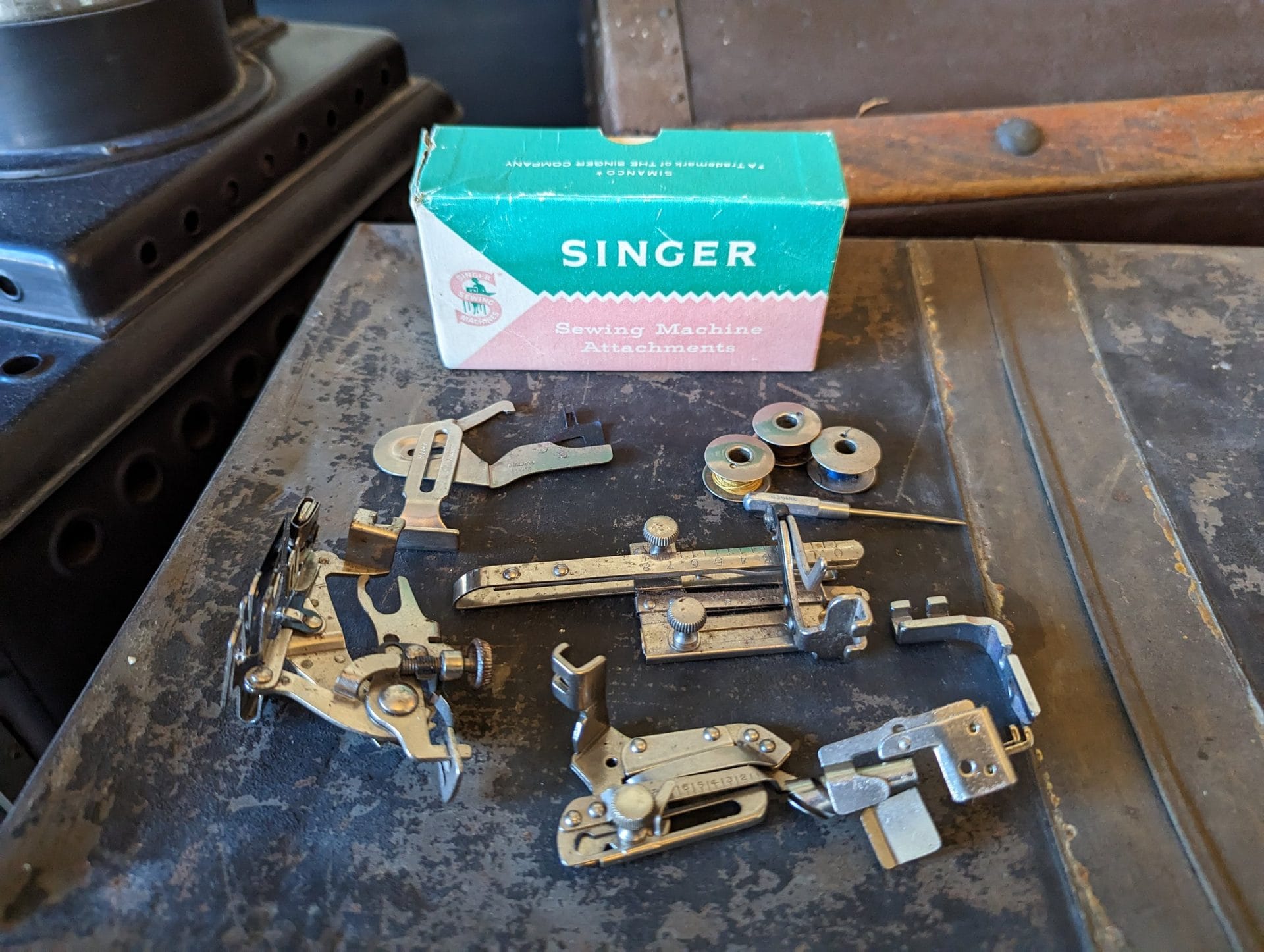
Some attachments (or accessories) could be harder to find than a machine, so they are often valued.
In determining the value, condition is paramount, but it’s also a nuanced factor. Machines in excellent condition with original decals, functional mechanics, and minimal rust will typically command higher prices. However, what constitutes “good” condition can vary depending on the machine’s age and typical wear for that model. Some collectors are drawn to machines in a “working antique” state, preserving the machine’s history, while others prioritize full restoration.
Restoration, however, doesn’t guarantee higher value. Original parts and patina are often prized, and in some cases, heavily restored machines are less valuable than those in untouched, authentic condition. Variations in expectations make condition a subjective factor, adding complexity to establishing fair market value.
The condition of the included accessories, original case, and instruction manuals can further impact the value.
Location can greatly influence the price and availability of Singer machines. Due to Singer’s massive international distribution, some models and variations are more accessible in certain regions. In areas with high demand, such as regions with active collectors, restoration shops, or cultural appreciation for antique sewing, prices tend to be higher. Conversely, rural or less populated areas might see lower prices simply due to a smaller market, making it easier to find valuable machines at lower costs.
Shipping also comes into play; machines are heavy and costly to transport, which can deter buyers and sellers from distant regions. Many collectors focus on buying locally, where prices are often lower, without the added cost and risk of shipping.
Price inconsistency highlights how demand, knowledge gaps, and even location can inflate or deflate perceived value. Given such unpredictability, collectors and enthusiasts often avoid making valuations, as every machine’s story and market context are unique.
About Documented Machines
Historical serial number records are an invaluable starting point, but they do not tell the whole story. To expand our database, we have started documenting information from surviving Singer sewing machines that have been examined in person by us or by experienced collectors who have shared their findings with us.
This project began while researching Singer production at the Monza factory in Italy and the Bonnières-sur-Seine factory in France. For these factories, many original records are incomplete or no longer available, making surviving machines an essential source of information.
By linking a specific serial number to a real machine, we can record details that are not always present in historical lists, including decals, model variations, factory information, and other identifying features. These documented machines allow us to continuously improve the accuracy of the database.
Knowledge becomes more valuable when it is shared. If you own or know of a vintage Singer sewing machine and would like to contribute information, please use our submission form, leave a comment, or contact us. Every contribution helps preserve this history and makes the database more useful for collectors and enthusiasts around the world. Thank you for helping us in this monumental research!
Share info about your machine
If you do know something about a Singer vintage sewing machine, please share what you know with the community! Thank you for helping us in this monumental research.
About this research
I had fair share of struggles myself trying to figure out the model and year of my first vintage Singer sewing machine. I knew serial numbers were the right tool for that, but browsing endless tables, especially on mobile, was not so easy. Since I am a coder for a living, I wanted to make things easier for me and for fellow enthusiasts.
I wanted a way to let people quickly identify key information about their machine with just a few clicks. I also didn’t want another app on my phone, so I made a simple webpage that can be accessed on any device, anytime, anywhere.
The data collected here is based on Singer’s historical records, as revised by the company in 2005 (you find them all here in the Resources section), double-checked with information from reliable sources such as ISMACS.
While we strive for accuracy, it’s important to note that the results may not always be perfect due to the age and origin of the records or the difficulty of mantaining a database of millions of machines. Please if you find inaccuracies or missing data, drop a comment or contact us!
Resources
- About Singer sewing machines serial numbers
- Serial numbers from the official Singer website, no letter prefix (archived by Wayback Machine)
- Serial numbers from the official Singer website, one-letter prefix (archived by Wayback Machine)
- Serial numbers from the official Singer website, two-letter prefix (archived by Wayback Machine)
- Serial numbers and relative information, by ISMACS
- Early machines serial numbers, by ISMACS
- Very early machines serial numbers, by ISMACS
- Factories and location codes
- Manuals in PDF
- Archive of Singer sewing machine manuals
- Comprehensive list of Singer sewing machine models
- How to identify a shuttle separated from its sewing machine
- Grace Rogers Cooper, The Sewing Machine: Its Invention and Development, 1976, The Smithsonian Institution Press
Changelog
List of major upgrades to the search:
- 6th October 2026: fixed a typo in the AB-series serial numbers
- 25th September 2026: fixed an overlap in the D-series serial numbers
- 30th July 2026: fixed an overlap in the EH-series serial numbers
- 17th June 2026: added link to the specific decal sets in search results
- 11th June 2026: fixed inconsistencies in the B-series serial numbers
- 16th April 2026: improved messages when serial number is not in the official records
- 4th February 2026: improved tables of location codes and serial prefixes
- 10th October 2025: added more info about documented machines
- 2nd September 2025: added lists of replacement parts to search results
- 2nd September 2025: added decals to search results
- 14th February 2025: added manuals to search results
- 16th January 2025: added verification to machine models
- 21st November 2024: fixed result errors for G-series
- 31st October 2024: added support for Italian language
- 30th August 2024: added useful links in notes
- 2nd May 2024: added count of total serial numbers
- 26th April 2024: first published
More resources


More on our vintage sewing machines


Did you know about Singer's jingle?
Did you know that Singer, in 1891, became one of the first companies which used a “jingle” music in an advertising campaign? The song “Merry Singer”, composed by Henri Le Verne for the company, made great contributions to reputation of Singer.
“The sun never sets on a Singer sewing machine at work!”.




96 Comments. Leave new
I need parts for a factory type machine. I make saddles. The machine is in bad need of repair, but I would like to save it. The model number, as best as I can read it, is AG437519. Your web site really helped me figure out some info. I’ve never done restoration of anything, so I’m really new at this. Thanks for your help.
M. Benson [email protected]
Hello! I am so glad I could help you! That’s the main reason why I built this page. Thanks for your comment, you made my day! Good luck for the repairs of your machine. Please, if you don’t mind, I’d like to know how the restoration ends. Have a nice day!
Also for the AG series there is the official PDF by Singer, that you could save or print for future reference: https://web.archive.org/web/20100107072018/http://www.singerco.com/pdf/SINGER_AG_nos.pdf
Hi,
For my model 358, your database is inaccurate and misleading .
I search for it’s serial number
M83493115
on your search engine and it returns as made in Scotland.
The machine says, “Made in Italy” which is cast on the underside, so in reality Monza.
Probably 1977.
Scotland factory closed decades before that.
I hope this helps you with your data.
Hello! Thank you for pointing it out.
The fact I think is the age of your machine: if it’s 1977, it goes out of the scope of our serial number database. As we point out under the search form, we cover machines up to 1971.
In the 1970s many factories modernized, the old serial number system changed dramatically. We have literally no way at the moment to list too modern serials. I know for many 1970s still count as vintage, and it really is, but the old serial system simply doesn’t work.
Please would you mind sending us a photo of the machine serial number and machine to see it and be certain of this? You can use the form or the Contact Us page. Thank you!
I need parts for a factory type machine. I make saddles. The machine is in bad need of repair, but I would like to save it. The model number, as best as I can read it, is AG437519. Your web site really helped me figure out some info. I’ve never done restoration of anything, so I’m really new at this. Thanks for your help.
M. Benson [email protected].
Glad to see a comprehensive database with links to other info! And thanks for explaining the allotment. I have a 20 one that was a lot of in 1951 but does not bear the centennial badge. Now my understanding is that it probably was allotted in ‘51 but not actually produced until later thus no Centennial badge.
Stupid spellcheck.!
I have a 201 that was allotted in 1951…
Maybe you also know the submodel? My goal would be to list all the info possible on the machines here, even the submodels or a tiny bit of history of the machine itself, if possible.
Thank you so much! I am really glad my database was of help. Maybe I should add this note about the Centennial badge. Would you mind telling me the serial number of your machine? Thank you again!
Stupid spellcheck.!
I have a 201 that was allotted in 1951…
Sometimes the spellcheck messes things up 😉 No bother!
This!
Is!
AWESOME!!!
So many things make more sense to me now. There are two lingering questions for me:
—I see references to 27 class machines but also to 27-1, 27-2, 27-3, & 27-4. The only time I’ve found anything on “-1” codes is in reference to Pre-1900 VS machines (VS-1, VS-2).
Do you know what the sub-classes are /are for on 27s and 66s? Do the sub classes have an impact on parts??
—I bought a 5-drawer treadle cabinet (with a 1908 66 Red Eye) to use with my 1903 Sphinx 27. I plan to box-n-crank the 66, but have been unable to find out if there are any markings/classes/codes for the table cabinet—do you know of a way to date those?
Thank you so much for all of your work. I’m sharing your site with my podcast listeners right now. 🥰
Hello! Thanks a million! I am so glad you found this useful!
To answer your questions:
* In the models you mention, 27 is the class, the dash is the “location code” (could be the indication the machine was built in Elizabethport in USA or that the factory is unknown, actually).
* I am sorry, I don’t have a reliable list of subclasses to suggest you… and they could have minor impacts on parts, for what I know. The best place I found to get help on those topics are Facebook groups of Singer machine collectors, they may have your very same model and point you to the right resource/part you are looking for.
* As for the cabinets, the best resource I know is https://ismacs.net/singer_sewing_machine_company/singer_sewing_machine_cabinets.html
I hope I have been helpful! Please share your podcast here, I’d love to listen to it! Thank you again!
Awesome post!
Thank you!
Thank you for this resource! I have used it multiple times for different machines. I recently acquired a gorgeous machine, and according to the serial number, it was made in 1855.
But it has the sphinx decal, which I’m reading wasn’t used during that time frame.
This machine is in stellar condition, but almost too clean to be 100 years old, let alone almost 150.
Wondering about the possibility of a really clean dupe?
Thanks a million, I am glad you found my resource useful!
As for your machine, are you sure maybe there isn’t another number in the serial that’s ben worn out by time?
Would you mind sending us photos via the contact form? I am curious about it! Thank you!
Thank you for such a wealth of information which provides me more about my grandmas treadle singer sewing machine.
My cousin just passed grandma’s sewing machine on to me, as I am the sewer in our family. I am also teaching my grandchildren how to sew and hope to share the wonderful memories I had as a child visiting grandma sitting at her Singer.
The serial number is K124714, which I found in your provided serial number search option.
It is in beautiful condition, given its age. It is housed in the original 6 drawer cabinet with a small pull out in front.
My grandmother told me she bought it new for $4. after she got married to grandpa in the 1920’s.
On the throat plate that covers the bobbin are patented dates Dec 5 – 1882, Sept 22-1885, July 19 -1887, Aug 21 – 1888, Jan 13 -1891. I am guessing these were the current patents of the day when my grandmother’s singer was made, but can’t find anything to confirm this. Was this the common practice?
I learned alot from your article. Thank you!
Oh wow, thank you so much! I am so glad to be of help! About the patents, I would have your very same guess, but no certainty, I’m sorry. Maybe you could contact ISMACS and ask them, they are super knowledgeable.
Thank you so much for clear information!! I’ve spent 4 hours today trying to figure out my machine!!! My aunt gave it to me since I’ve been sewing since my teens:-) I couldn’t figure out what I have until your website!! I now know I have a model 127 from 1917!! But just to be sure…lol,my serial number is G5441992. Can you confirm that I’m correct? Thank you so very much!!! Traci
Thanks a million for your comment! I am glad I could help you! As far as I know, those are the info about your machine. You can also post photos of your machine in collectors’ facebook groups to confirm the model is correct. Sometimes the serial numbers were allotted for a certain model, but the machine that was actually manufactured happened to be a different model. Please let me know if you find more info on your machine, so I can update the database and keep is as accurate as possible! Thank you
Thanks for the article i hapoened across it by chance. I have a singer machine thst belonged to my geeat aunt.its singer. G5225644 elizibeth port, NJ model 66 date 2/20/1917 50,000 manufactured. It is in excllent shape , three drawers on each side abd a tilt out drawer on the front it is filled with period sewing supplies and pedels freely. Now what do i do with it? Does it have any monitary value or strictly sentimental. My great great aunt gave it to my mother and finally made it to rest at my house for the last 40 years. Im old now and my siblings arnt interested in it.
I am glad this page could help you! Thank you for your comment. About the machine, if you don’t have any interest in keeping or using it but your siblings have, I would think about giving it to them. But this is because I love seeing those machines used! About the monetary value, try with a quick search on Ebay to see the price of similar machines, same model and year and in the same condition. It’s the best way we have to determine the value, since it can change greatly depending on demand for the machine, region, conditions… The same model could vary a lot. In the US I’ve seen machines valued a lot more than in Italy where I live. Also, you could ask collectors on specialized facebook groups. Those groups are an invaluable source of information about vintage sewing machines!
Thank you for the information dating my singer portable sewing machine to 1891. Who do I have to contact to get an appraisal value for the machine?
I am glad I could be of help! As for an evaluation, you could try with ISMACS or singersewinginfo.co.uk. Also facebook groups of collectors are a valuable source of information, and you could also find buyers there. Good luck with your machine!
Thanks for linking to us here at ISMACS. My name is Calvin and I am the current Chair of ISMACS. Got your email and headed over to take a look and see what you had going on. Nice site.
We don’t, however, do valuations. There are far too many variables including scarcity of machine, condition of machine, location of machine, etc. There is a good article on the ISMACS site that lays out the pitfalls and why we don’t, and a funny rant over at Zorba’s Secret Sewing Machine Page. For example, you will routinely see Singer 66 Redeye decaled machines listed on ebay and FB Marketplace for well in excess of $1000. I bought one recently with decent decals and in good shape for $15 in a nice treadle stand. That’s the kind of thing you run into. Fun story, someone on Victorian Sweatshop was looking to buy a machine and the seller wanted significant amounts of money, far more than it was worth. When the buyer suggested that it was overpriced, the seller pulled out a FB listing for one that was the same price. Turned out that the FB listing was one that had been completely restored [b]by that buyer[/b].
Also, in reference to a previous post, the -X number on a Singer sewing machine model tells you the variation, not the factory. 12K would have been made in Kilbowie, Scotland, but 12 would have been made wherever Class 12 machines were being made. Other than that few Singers had factory designations in their Class name. A -4 in that serial would tell you that it was the fourth variation (usually significant changes as Singer sometimes did smaller changes from year to year without changing the designation). Many parts lists cover multiple variations and you just have to be careful when you are looking for parts for your particular machine that it isn’t one of the changes.
Anyway, looking forward to digging around on your site.
Hello. Thanks a million for your kind and explanatory comment! I really appreciate you took the time to read my email and visit my website.
Your work is amazing, it would deserve more than just a link.
Thank you for explaining the variables about a machine evaluation, I’ll add a note about that in my articles as well.
I also have to update the info about the variation. Thank you so much for helping me improve my website.
I’ll keep up- to-date with your wonderful work at ISMACS.
I have a Singer Treadle sewing machine in its cabinet with the serial number
Y2769531.. I am a little confused as to the date it was manufactured and where it was made. Could you help please. Thank you. Anne
Hello. Just insert the serial number in the form at the top of this page. You’ll get this:
Serial Number: Y2769531
Factory: Kilbowie, Clydebank (Scotland)
Model: 66K
Year allotted: 1925
Date allotted: May 26
Quantity allotted: 35000
I was given a a singer EH150321 can you tell me more about this machine it’s history in depth and poss how much it sold for when it first went on the market and what it might be worth now and where I could get owner & user manual and where I could find parts for it and does the kilbowie factory still exist today
Hello. Those are hard info to find 🙂 It seems from the serial number that you have a 206K made in 1952. More on your model on https://www.singersewinginfo.co.uk/206. About the manual, with the model you can browse the Resources here in this page: I linked a collection of PDF manuals. I hope yours is there, too! Knowing the value today is tricky, since it depends on your location, the conditions of the machine, if it’s working etc… I suggest you contact collectors or museums and send them detailed photos of your machine. Maybe also a video of it working. Moreover, Facebook has a couple of interesting groups where you find knowledgeable people who can help you more than me. Look for the Old School Singer Sewing Machines group. Good luck with your machine!
I appreciate your sleuthing to track down the records. The machine belonged to my mother.
Thank you so much! It’s a rewarding challenge. Have fun with your mother’s machine!
I am looking for bobbins and bobbin cases for a pre 1900 singer sewing machine model #84570184 don’t know how to find them. Thank you for helping
Hello! The number you are referring to is the Serial Number. The extant records unfortunately stop at number #16894584. To determine the model, you have to show your machine to knowledgeable experts. Try posting a photo on the facebook group “Old School Singer Sewing Machines” or contact ISMACS or other collectors’ societies, even museums. I contacted all of them in several occasions, I always found helpful people willing to help. I hope you find info about your machine. Enjoy it!
Based on using the serial number on my newly acquired machine (EC860146) in online databases, it is listed as a model 15K, from 1940, one of 100,000 made in Scotland. But, when I go to sites that provide photos, features, components, repair or refurbishing info, this very much appears to be a model 99 and not a model 15K. My machine does have a made in Great Britain decal. The tensioner faces the operator, not by the faceplate. The faceplate is flat with scrolls. The baseplate measures about 12 inches end to end. This sewing machine looks like my wife’s model 66 only smaller. A knob exists to adjust the stitch length. As well as other telltale signs of a model 99. Could it be that the Ismacs database is incorrect and the other date sites like decoder use this incorrect information. I can provide one or more photos if this would help to properly identify my machine. I will need it for a user or parts manual and to get parts or assistance when the time comes. Sincere thanks in advance, tony. Please don’t share my contact info other than for you to reply. Thank you again
Hello. That discrepancy is normal. Serial number records register what Singer wanted to do, not what they did eventually. They allocated a certain batch of serial number to be associated to a certain production of machines of a certain model in a certain factory. And they recorded this decision. In the end, for multiple reasons, they could end up giving a specific serial number to an entirely different machine. The actual needs of factory production could differ from the initial decision. Besides, those records are old, sometimes really old, so having errors is to be expected. A serial number can give an idea about the date and model of a machine, but this is just a starting point. Checking with photos and experts is indeed the best thing to do.
I thank you so much for reaching out to me about your machine. You could check with collectors to help you identify the model with certainty, maybe by posting photos on facebook groups like “Old Singer Sewing Machines” or getting in touch with museums. I will update the records so the model matches the real one of your machine.
And be sure I’ll never share your info! The only reply you’ll have from me, if not directly requested, will be through your own comment here.
Have a nice day and enjoy your machine!
Good morning i have just moved house and come across a singer sewing machine built into a table, serial number F6563775 from what i can work out it was built in clydbank singer factory in 1915 model 127k. Is this something that can be repaired.
Hello! Congratulations on your machine. Well, without seeing the machine, it’s hard to tell how it’s damaged and how repairable it is. I suggest you to post photos in forums like the Victorian Sweatshop Forum or on facebook groups like “Old School Singer Sewing Machines”: they gather knowledgeable collectors who can help you for sure. What I learnt myself is that, even when you think such an old machine is badly damaged, in the right hands it can still be repaired. Those machines are often defined “workhorses” for a reason. So don’t give up, seek for someone to service your machine and it will work again. Good luck!
I have a Good Housekeeper sewing machine. Model# 203
Ser# 95258
Just wondering what year it was made? It also runs when plugged in. Thanks for your time.
Hello. I am sorry, I know nothing about that brand 🙂 This database is for Singer machines only. Did you try the Victorian Sweatshop Forum? Sorry I couldn’t help 🙁
How can I find out how rare is and the current market value of my singer sewing machine, code EB153857?
Finding the value of a vintage sewing machine is tricky. It depends on where the machine is, its conditions, the accessories it might have…
Is the machine in working state? Does it look good? Are the decals worn out?).
It’s literally impossible to give a market value without seeing the machine, and without knowing its location.
I suggest you read this paragraph to know more on the info you need to get a valuation: https://www.lrcrafts.it/find-vintage-singer-sewing-machine-info/#value
I suggest you, also, to send pictures of the machine to museums or to post them on the Victorian Sweatshop Forum or on Facebook groups like “Old Singer Sewing Machines”. There’ you’ll find collectors in your area that may help you have a price range.
Valuating an antique is tricky, in the end it depends on finding the right person who’s interested in the thing and willing to pay you the sum you expect.
I wish you good luch with your machine.
Thank you for your hard work and research into the Singer sewing machine. I did find the Model 307 G based on one set of seral Number PB 500057 but this machine has another set of numbers inscribed on the bottom edge of the main body. The machine body has to be lifted to see them. The number is 506737. It was classified as a Model – New Family and allotted in 1871, made in Mott St New York.
This had me confused a little bit. I have the Instruction for Use handbook. It is titled a combination zigzag sewing machine for tailoring. It is in threadle form. Could you provide me with more info on this one. It is not very pretty looking.
Hello! I think the number you used is correct. 506737 could be instead a part number. Online you can find several “List of parts” booklets where, for each model, you find listed replacement parts with their code. You can be sure the 506737 is not a serial number because serials without letter prefixes were dropped after 1900. A 307G model has the location code telling you the machine was made in Karlsruhe, Germany. That factory opened in 1954 (find reference here https://www.singersewinginfo.co.uk/karlsruhe). Also, your 306-class machine was introduced in the 1950s: reference on https://www.singersewinginfo.co.uk/306.
I hope I could clarify your doubts!
Buenas tardes, los saludo desde cali colombia
Tengo una máquina de coser al parecer singer serie 375774
Agradezco me puedan regalar todos los datos de esta máquina
Gracias
¡Buen día! Introduce tu número de serie en el buscador de https://www.lrcrafts.it/find-vintage-singer-sewing-machine-info/ y obtendrás toda la información necesaria. ¿Estás seguro de que el número que indicas es el número de serie? Lee el artículo completo para saber exactamente dónde encontrarlo y cuál es el formato correcto para identificarlo. Ese código también podría ser un número de pieza. Si ese es el número de serie correcto, tienes una máquina de coser Letra A de 1860. Compruébalo y, si necesitas más ayuda, estamos aquí para ayudarte. Las fotos de la máquina serían de gran ayuda para identificarla. Gracias.
***
Good day to you. Please insert your serial number into the search form at https://www.lrcrafts.it/find-vintage-singer-sewing-machine-info/ and you’ll get all the info you need. Are you sure the number you list here is the serial number? Please read the full article to know exactly where to find the serrial number, and what is the correct format to identify it. That code could also be a part number. If that is indeed the correct serial number, you own a Letter-A sewing machine from 1860. Please doublecheck, and if you need more help we are here to assist you. Photos of the machine would help identification a lot. Thank you.
Singer 18-7 new jerseys quante ne esistono?
Difficilissimo a dirsi! Sapere quante ne esistono è praticamente impossibile, si può però stimare quante Singer 18-7 siano state segnate nei registri che ci sono rimasti.
Nei registri, si trovano oltre 200mila macchine prodotte nel New Jersey della classe 18. Non sono conservati dati però sulla specifica variante 18-7. Solitamente i registri riportavano l’assegnazione dei numeri di serie per la produzione di una classe, difficilmente registravano anche le sottovarianti di quella classe che venivano infine prodotte.
Hai una macchina modello 18-7? Posso chiedere il numero di serie per provare ad approfondire?
Really helpful thank you!
Thanks a million to you!
I am trying to find iformation for my old Singer machine. The serial number C61354133. The plate also says Made by Singer in Brazil.
No model numer or other ID. Help please!
Hello. Unfortunately, the records for serial numbers beginning with C are lost. A photo would help identify the model, though. You can send it through the About section of this website. I also suggest you to visit the Victorian Sweatshop Forum or the facebook group Old School Singer Sewing Machines: both places are full of helpful and knowleadgeable people. Good luck!
Minha máquina tem o número de série 1511963056 fala que e de 1899.
Sim, se for esse o número, pode muito bem ser. Aproveite sua máquina antiga!
I have just picked up a singer frame/stand without the sewing machine. I was wanting to work out the age of it if possible. There are numbers stamped into the frame and I was wondering if this the same number that would have been on the sewing machine. Nobody seems to mention anything about numbers stamped in the stand.
The numbers are 18 then below are 46800
Any help would be appreciated.
Thankyou
A photo would be really helpful here. As for instruction manuals, “lists of parts” were published, where you could look for a specific sewing machine model and locate replacement parts to order. Each one had its own specific number. It would be tricky to research though… as I know, there is no such thing as a complete database of all the part numbers used… maybe a suggestion for a future research though! I do have some lists of parts published, try to browse them here: https://www.lrcrafts.it/manuals-vintage-singer-sewing-machines/#lists. Hope this can help…
Sometimes, though, the best thing is going to forums or Facebook groups of collectors, post photos there and see if anyone has a similar thing and knows what it is.
If you’d like to send a photo, please use the contact form in our About page. Thank you and good luck with your research.
Geachte,
Onlangs een Singer aangekocht . Bij de zoektocht naar identificatie op serienummer kom ik op 2 mogelijkheden van fabricatieplaats. Eerste is Elizabethport , New jersey (VS). Tweede is Kilbowie, Clydebank Scotland (VK).
Over de datum , deze komt op 26 mei 1925.
De Singer staat op een tafeltje met voetpedaal en moet gerepareerd worden. De machine heeft buiten gebruikssporen weinig schade maar dit ga ik zo laten. Dit maakt de machine tot wat het is . Namenlijk; antiek.
Hello. So you mean the same serial number got you two possible locations? No clues about this without knowing the serial number. Could it be a serial beginning with JA, JB, JC etc. ? Until 1924 serial numbers for machines made in Canada were issued by the Elizabethport factory in New Jersey, USA. After 1924 the St. John’s factory issued its own serial numbers, beginning with JA, JB, JC etc. followed by 6 digits. Please if you need assistance, provide the serial number 🙂 Thank you
MB468273 306M Australia
Thanks a million!
I have a Singer L530891. I don’t know much about it but it’s beautiful!
Maybe if you send a photo I’ll be able to help you with the identification of the model. I am sorry, but the official records for L-series start at serial L627301. Feel free to send images via the About Page contact form!
9/13/2025 Looking for your list of the Italy Singer sewing machines that people have updated you with for your ongoing list, want to add this one to the list- MB695630 —Singer 306M (black), no paperwork with the machine, she is lovely. Montana USA..
Wow, thanks a million! Adding to the database right away 🙂
Hi,
I was delighted to find this page, and the link to a manual for my 1897 Singer 27 – but when I clicked on it, I got “It appears you don’t have
permission to access this page. 403 Error. Forbidden.”
Is there a way to get access?
Thanks,
Helena
Hello. Sorry about that! I did check, and the link to the manual comes from the ISMACS website but it seems broken, here’s an alternative link: https://web.archive.org/web/20231209203800/https://ismacs.net/singer_sewing_machine_company/manuals/singer-model-27-number-2-vibrating-shuttle-sewing-machine-manual.pdf
Did you try exploring the manual collection here? https://www.lrcrafts.it/manuals-vintage-singer-sewing-machines/#manuals
Thank you so much for compiling this information!! I have a 66 (G1558388) in a cabinet. Thought it was a family heirloom but my mom just told me she bought it at a garage sale like 50 yrs ago!! for 5 bucks. I am selling it to my young Amish neighbor.
Thanks a million to you! I am glad you like my resources! If you’d be willing to send me a photo of your machine, I’d love to update the database adding it. Thank you again!
Hello. I love the work you have done here. I have found your search tool very useful as I help folks in the vintage sewing community near me. Here is the address to my project with a collection of machines in our care. Let me know if I can support your efforts in any way. http://www.thesewingmachineorphanage.com
Thanks a million! I am really glad I was helpful! And thank you for your link! I see you do a lot of work on your own about vintage machines. Maybe we could help each other out!
Hello,
My MIL passed and left me a Singer sewing machine. The only information I have on it is the serial number: C80584459. It has red on the front. I believe it is fairly new.
I have no instruction booklet, and it appears to be missing some smaller parts. Would you please help me find the information required? Thank you so very much!
Please, would you like to send us photos of your machine using the form on the About Us page? Maybe we can help you identify the model and locate a manual.
Hello. The serial number seems long to be a vintage machine. Our database covers machines up to the beginning of the 1970s.
While cleaning out the house for moving I found what is possibly my great-grandmother’s Singer 12K. She lived from 1852 to 1904, had 11 children, and almost all the decorations on the machine have been worn off, so it has seen heavy usage. Other than that the machine is in good condition. If it was actually her machine cannot be 100% verified, but it’s what’s most likely as there aren’t really many alternatives.
It has two serial numbers:
No. 1 is 7676668
No. 2 is 19359268
From the database I interpret this to be a 12K from Clydebank Kilbowie, and, as it has two serial numbers, made before 1889?
Hello and congratulations on your machine. Are you sure about the serial numbers? Those could be part numbers. Because the pre-1900 records stop at n.16894584. If the machine had two serials, yes, it would have been before 1889, when Singer dropped the two-serial practice. Would you mind sending us photos of the machine and the numbers? We might be able to help you identify the correct numbers. Use the “Suggestion form” here please. Thanks a million!
Thank you for your reply. The suggestions form seems to only allow a single photo? If so, will a photo of the numbers, or a side-photo of the machine be preferrable? It’s hard to get a single photo with both.
Please start with numbers, I’ll reply to your message via email so you can send me more photos if needed. Thank you!
(The single file limit is mainly for spam reasons 😉 )
Quiero encontrar datos de una máquina de coser SINGER Z273529
Hola. ¿Has probado la búsqueda en la parte superior de esta página? Si necesitas más, envíanos fotos de tu máquina mediante el formulario aquí.
Can we send pics on this page?
Sure! Just use the provided form here. Thank you!
hello I inherited my great grandmother’s sewing machine. I am the only great grandchild that she taught to work on it as a child and to sew. it was passed down to other members and it got severely damaged my heart broke so I took it and was very angry with them all along with her stoves and other things. so now I am in need of repairs and replacement of some parts my model number is G575919 ITS A 66 SERIES I think is what she said but I miss sewing g on it looking for manuals and a plate and the little things it came with please if anyone can help I really appreciate it and any information about this mechine id love to share with my family once it completed thank you
Hello! I am sad about the machine getting damaged… Did you try searching for your serial G275919 on this page? You should get model, year of production and if available also manuals. To find replacement parts, you could benefit from a list for your model. Find one here. For repairs, you could also look for an expert in your are, we have a map available. Please if you still need guidance, send us images of your machine, maybe we could guide you.
Yes
Sorry, yes to what? 🙂
I just acquired a Singer Fashion Mate, serial number MG783923.
Thanks a million for sending us the serial! Do you know the model number? It’s usually stamped onto the front of the machine. Thank you again!
Serial Number: eb061522
Factory: Kilbowie, Clydebank (Scotland, UK)
(Years of operation: 1884 – 1980)
Factory location code (Learn more): K
Model: 201K
Year allotted: 1937
Date allotted: June 10
I have been given this machine to be scraped. It s in Belfast Northern Ireland. If a collector wants it I would rather it was saved than dumped
Hello, thank you for reaching out to us! We are far from you, but there’s a group of Irish collectors here you could send photos to. I am sure someone there will love this!
Found a singer sewing machine for sale on facebook, with a picture of the base showing serial number 8435988, also stating on the metal tag that it was made in Canada. Your data base says it was made in Kilbowie.
Hello. Machines with serial numbers without prefix letters could not be made in Canada: numbers only were in use up to 1899, Canadian-made machines have prefixes like Ja, JB etc but from 1924 onwards. I suspect that is not the serial number, but a spare part number. The confusion is easy. Would you mind sending me a photo, so I can verify? It could be that the numbers is indeed the serial, with the machine not made in Canada, or the machine was really made in Canada, but has another serial. Thank you!
I have a 185J with serial number ET574076. The database incorrectly says a 99K (from 1962).
Thanks a million! It’s not the first time we encounter a 185 where allotment records have a 99. It’s an important update to our database, thank you again!