
When we think of Singer sewing machine factories, places like Elizabethport or Kilbowie ar the ones coming up more frequently, due to their size and long history. They produced billions of machines and have the most accurate surviving serial number records. Another factory that comes up quite often was built at Saint-Jean-sur-Richelieu, Quebec (Canada), a factory that is usually referred to simply as St. John’s.
It was certainly not overshadowed by the biggest international factories. The St. John’s plant eventually covered about 45 acres and consisted of more than 18 buildings, with its own railway tracks, foundry, power facilities, woodworking operations, and other departments needed to manufacture sewing machines and their furniture. At its height, the factory employed thousands of people.
Unfortunately, though, this factory did not preserve accurate production records, as its bigger sisters did. We are documenting several surviving machines made in St. John’s, and here you can find the results of our research: the decals in use, a brief history of the plant, useful statistics, and more. Since our project is still ongoing, you can come back from time to time to check what we have found so far.
If you want to check whether your machine was made in this factory, enter its serial number in our lookup tool. And if you would like to contribute to our research and help us cross-reference the data, please send us information about your Singer machine. Every machine we document can help others learn more about their own Singer machines.

Table of contents
Brief history of the St. John factory

Singer operated two manufacturing facilities in Quebec. The first was in Montreal, but as the company continued to expand its Canadian operations, a much larger factory was planned at Saint-Jean-sur-Richelieu. Construction of the new plant began in 1904 and took two years to complete, with more than 800 workers involved in its construction. The total cost exceeded one million dollars: a remarkable investment at a time when that represented an enormous sum, that would be approximately $37.5 million in today’s money.
The choice of Saint-Jean-sur-Richelieu was not accidental. The city offered Singer a number of substantial incentives to establish its factory there, including tax exemptions, financial assistance, land for the plant and employee housing, and even a railway connection. In total, more than half a million dollars in grants and other incentives were reportedly offered to the company. When it was inaugurated in 1906, the new St. John’s plant was said to be 25 times larger than any other one previously opened in Canada.
The factory occupied approximately 45 acres and consisted of more than 18 separate fireproof buildings, with a total floor area of more than 12 acres. Around five miles of railway track were laid throughout the premises. This was not simply an assembly plant: St. John’s was an integrated manufacturing complex, with a foundry, woodworking department, engineering and electrical departments, warehouses, garages, assembly facilities. The wooden furniture for the sewing machines was also produced on site. At one point, the only major component that was not manufactured there was the needle, which had to be imported.
The factory quickly became an important part of the local community. At its peak in the 1950s and 1960s, around 3000 people worked at the plant. The complex was so extensive that it even had its own fire brigade and company newspaper. Singer also operated employee social activities and eventually established a pension plan. Machines and furniture produced in St. John’s were sold throughout Canada and exported to countries around the world: we documented surviving machines with St. John’s serial numbers and the indication “M.R.” (“Marca Registrada”), in use in Mexico. In the post-war years, machines manufactured there were reportedly shipped to more than 48 countries.
The Second World War brought a temporary change to the factory’s production. Like many industrial plants of the period, St. John’s was adapted to manufacture war materials. After the war, sewing machine production resumed, and Singer took the opportunity to modernize and expand the facilities. A new foundry, warehouses and garages were among the improvements that helped usher in what became the plant’s most productive period.
The factory celebrated its 50th anniversary in 1954. At that time, approximately 1500 people were employed there, under the management of Works Manager Ralph P. Benn. During the following decades, however, the fortunes of the factory gradually changed. Labor relations became increasingly difficult, with employees organizing and going on strike several times between the 1950s and 1980s. At the same time, Singer’s market share declined and demand for domestic sewing machines decreased as social and economic changes altered the sewing-machine market.
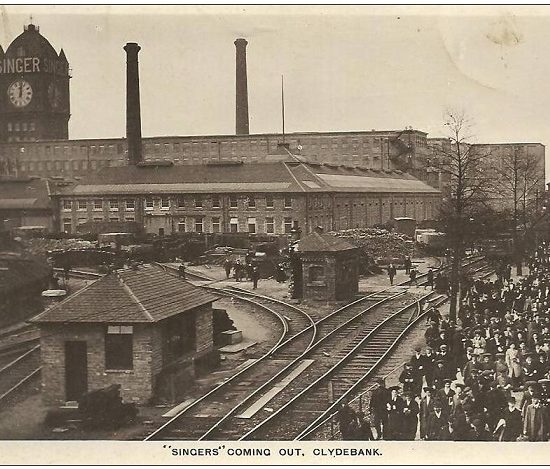
The St. John’s factory finally closed in 1986, bringing more than eighty years of Singer manufacturing in Saint-Jean-sur-Richelieu to an end. The original factory buildings were eventually demolished and the site was redeveloped. Very little remains today to indicate the enormous industrial complex that once stood there, although some photographs survive as reminders of the factory and the thousands of people who worked there.

A connection with the forests of Québec

There was also an interesting connection between Singer’s Canadian operations and the forests of Quebec.
Singer acquired timberland in the Eastern Townships, including the area around what is now known as Mont Singer in the Sutton Mountains. Between 1918 and 1940, Singer used timber from this area to produce wooden furniture for its sewing machines.
A small lumber camp known as Singerville grew up near the Ruiter Brook while logging operations were underway. In addition to the sawmill, the place included a cookhouse, bunkhouse, stables, blacksmith shop. The mountain still bears the Singer name today, as a reminder that the company’s activities in Canada extended well beyond the factory walls.
Serial prefixes, location codes, and production years
Here are the recorded factory identification details for St. John: its location code, serial number prefixes and years of operation.
The location code is the letter found in the model number that identifies the manufacturing site of a particular machine. On the other end, serial prefixes are one or two letters at the beginning of the serial number that distinguish serial number ranges assigned to machines produced at different factories.
Identifying machines made at St. John’s via their serial number
One of the most useful clues for identifying a Singer machine made at St. John’s is its serial number.
When the St. John’s factory began producing sewing machines in 1906, the serial numbers for machines made in Canada were not issued by the Canadian factory. Instead, they were assigned by Singer’s Elizabethport factory in New Jersey. This continued until 1924, which means that an early Canadian-made machine can have a serial number that looks no different from one assigned to a machine made elsewhere.
In 1924, St. John’s began issuing its own serial numbers, which consist of a two-letter prefix followed by six digits. The prefixes began with JA, JB, JC, JD and JE, with each series running from 000001 to 999999. Also, models manufactured at St. John’s began to be generally identified by adding a J suffix to the Singer class number. For example, a machine might be identified as a 15J rather than simply a 15.
We know the years of production of the different prefix letter batches:
- Serial beginning with JA were produced in the years 1924-1936;
- Serials beginning with JB were produced in the years 1936-1948;
- Serials beginning with JC were produced in the years 1948-1954;
- Serials beginning with JE were produced after 1961.
We do not know of machine yet with serials going on from JF to JZ.
During the later years of the factory, St. John’s also received partially assembled machines from other Singer factories, including Kilbowie in Scotland. These machines could be completed at St. John’s and sold for the Canadian market. As a result, some machines carrying St. John’s badges or other indications that they were finished there can have serial numbers originating from another factory. Kilbowie serial numbers, in particular, can therefore turn up on machines associated with St. John’s.
There is another problem: unlike some of Singer’s larger and better-documented factories, the original production records for St. John’s have not survived in a form that allows us to reliably match every serial number to a production batch with date and machine model.
This is why surviving machines are so important to our research: every single documented machine can provide a useful piece of evidence. The more machines we can document, the clearer the story of Singer’s St. John’s factory becomes. Please help us gather more data.

Date your machine
Insert your serial number in your lookup tool to date your St. John’s machine. If we did document your specific serial, you will also get info on its model and decals.
Decals from the sewing machines made in St. John
Here are the decal sets recorded on machines made in the factory of St. John, with their periods of use and the classes (models) they were applied to.
It’s a cross-reference of known Singer decal sets with the serial numbers in our own database. This may be helpful to date machines when serial records are incomplete.
Use recorded from 1934 to 1957
The Celtic Swirl has an "S"-like motive in the middle of the bed, and all the bed is surrounded by swirling motifs. Used on 128-class machines.
Documented machines in this factory
(What does it mean?)Total documented machines: 35
Documented Classes:
- 127
- 128
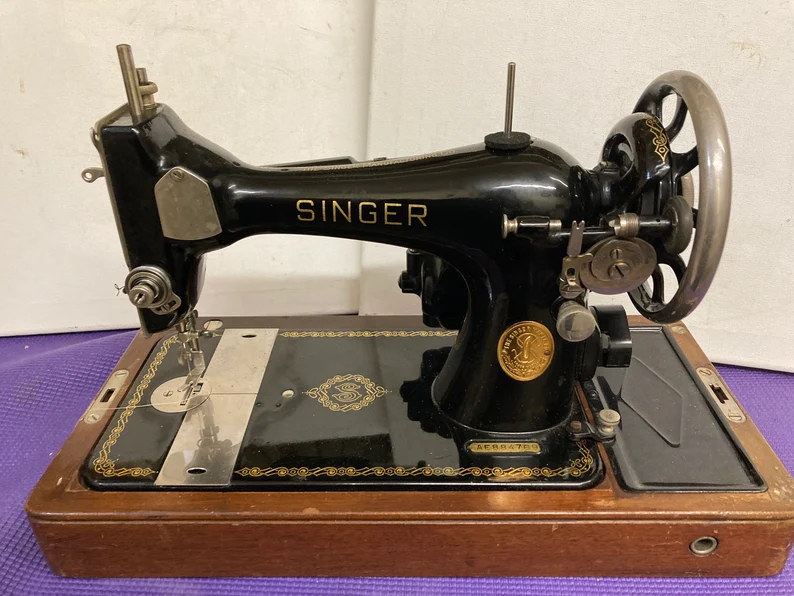
Use recorded from 1955 to 1968
This decal has a repeating geometric trapezoidal border pattern, that goes all around the bed and makes an oval eye in the center.
Documented machines in this factory
(What does it mean?)Total documented machines: 2
Documented Classes:
- 191

Use recorded from 1921 to 1955
This decal is sometimes called also "Triplets". Commonly used on 15-class machines. We recorded also a couple 66-class with these decals, but it could be a later application of decals on an older machine. Those 66 models were manufactured two decades before the patent for the Trefoil decals was filed. We also recorded a few 24-18 machine with Eye and Trefoils decal, produced before the 1931 patent for this decoration was files. It's indeed possible the patent was filed after the set had been used in production batches. Notice that the patents, while not mentioning specific models, seem to picture class 15 machines or similar.
Documented machines in this factory
(What does it mean?)Total documented machines: 91
Documented Classes:
- 15
Documented years: 1939 - 1946

Use recorded from 1930 to 1953
The so-called "Godzilla finish" is also known as "crinkle" or "wrinkle" finish. Because of the nature of the crinkle paint, the decals are usually fainter than the more common bright golden decals. "Godzilla" models seem to have been manufactured with non-crinkle shiny drive wheels.
Documented machines in this factory
(What does it mean?)Total documented machines: 1
Documented Classes:
- 880
Documented years: 1908

Use recorded from 1911 to 1929
Gold Wings decals were applied mainly on 115-class machines, but also on the more common 15-class machines.
Documented machines in this factory
(What does it mean?)Total documented machines: 7
Documented Classes:
- 15
- 115
Documented years: 1911 - 1919
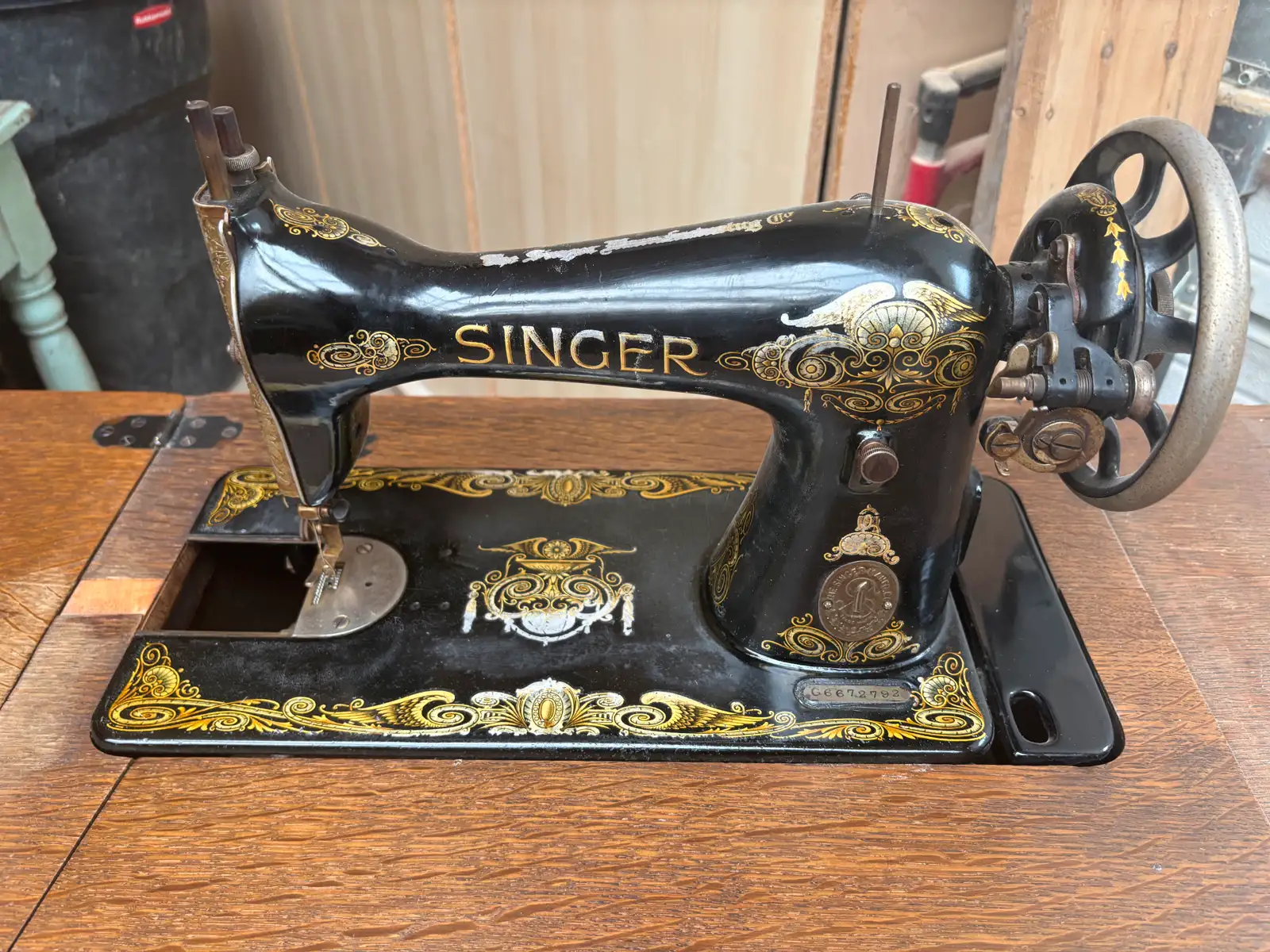
Use recorded from 1924 to 1950
The pattern around the border of the bed features interlacing heart shapes. Two interlaced hearts are also on the front of the machine, surrounding the Singer logo on the arm.
Documented machines in this factory
(What does it mean?)Total documented machines: 10
Documented Classes:
- 127
- 128
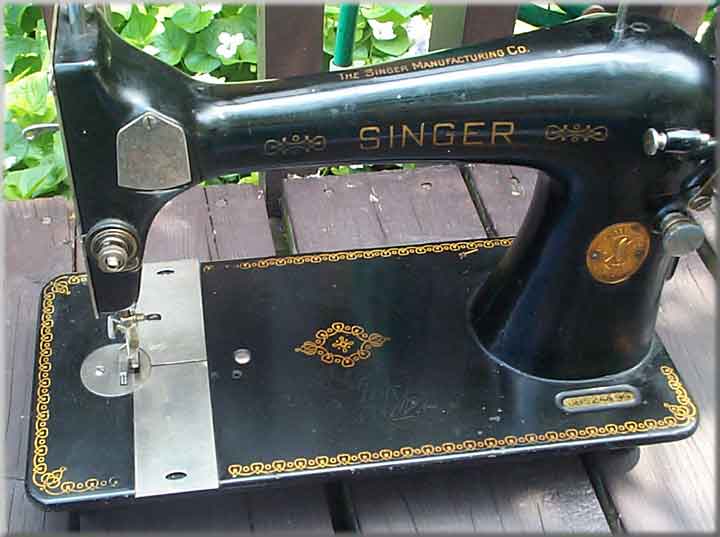
Use recorded from 1902 to 1960
The name means "The Victrix"
Documented machines in this factory
(What does it mean?)Total documented machines: 6
Documented Classes:
- 127
- 128

Use recorded from 1931 to 1960
This decal features simplified motifs designed by William Hopper from Dumbarton (Scotland) and patented in 1931. Since he worked at the Kilbowie plant in Scotland, the most part of the machines with RAF decals come from this plant, but it was used also in other factories. For example, we know of a 191R machine made in Mexico that has RAF decals, but it had no serial number to record it in our database. The center of the bed features a stylized bird in flight combined with geometric or lightning-like lines, resembling a seagull or eagle. The name "RAF" stands for Royal Air Force, a colloquial nickname given by collectors. For many, the central geometric shape in the transfer pattern bears a passing resemblance to the circular roundel insignia used by the British Royal Air Force. No real connection with the Royal Air Force, but the name reference stuck nonetheless. We recorded a machine with RAF decals from 1912, but it seems those decals were re-applied afterwards during a restoration. The first machine with actual original RAF decals comes from 1931.
Documented machines in this factory
(What does it mean?)Total documented machines: 3
Documented Classes:
- 15

Use recorded from 1886 to 1959
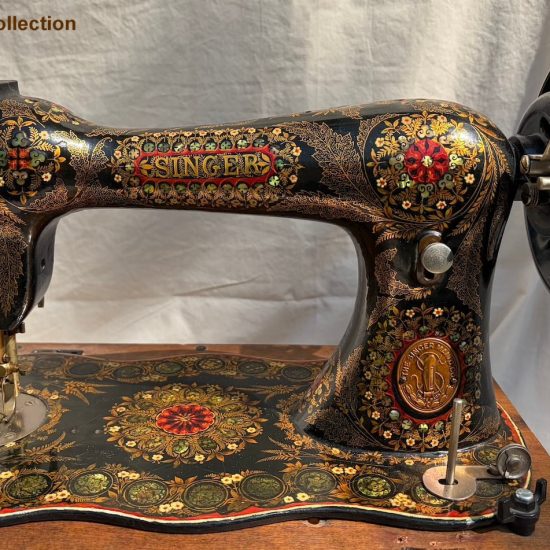
Also called “Egyptian” decals, they first appeared in the 1890’s. They were used on the class 15 and class 27 up to the 1950’s.
Documented machines in this factory
(What does it mean?)Total documented machines: 9
Documented Classes:
- 27
- 127
Documented years: 1910 - 1915

Use recorded from 1887 to 1930
This design is known as Tiffany or Gingerbread. There are two known variants of the Tiffany decal: what changes is the design under the logo metal badge. The earlier style has a triangle-shaped design under the logo badge; the more recent style has a "bird's nest" design below the logo badge, with such badge resting inside the "nest" or slightly raised higher up. No information about when the style changed.
Documented machines in this factory
(What does it mean?)Total documented machines: 4
Documented Classes:
- 15
Documented years: 1910

Use recorded from 1885 to 1941
Commonly seen on 28 and 128 models, we also documented class 39 machines with this kind of decoration. In use from the 1880s up to the 1940s.
Documented machines in this factory
(What does it mean?)Total documented machines: 1
Documented Classes:
- 28
Documented years: 1912

Share info about your machine
If you happen to own a Singer sewing machine made in St John’s, feel free to get in touch and share your machine’s serial number (and photos, if you have them). Each one adds another piece to the puzzle. Please share what you know with the community! Thank you for helping us in this monumental research.
Classes from the sewing machines made in St. John's
Here are the classes recorded on machines made in the factory of St. John, with their periods of use and the decals applied. The class is the core mechanism design (the base machine type), while the full model number combines that class with a factory code and a sub-version variant indicating specific features. For example, a model 15K88 is sub-version 88 of class 15, while “K” is the factory location code for Kilbowie.
It’s a cross-reference of the classes we associated to serial numbers in our own database. This may be helpful to date machines when serial records are incomplete.
15
Use recorded from 1879 to 1963
Successor to the "New Family", was the "Improved Family", which was given the class 15 designation. Originally patented by Singer engineer P. Diehl in 1878 (UK patent 2813, 13th July 1878), the 'Improved Family' was launched in 1879 as a treadle machine, lock stitch oscillating shuttle. It has the tension on the face plate. By the 1890s the name 'Improved Family' had been dropped and replaced by "Class 15". In the same period, the had received a serious upgrade. It had the most common domestic variant and also several industrial variants.
Documented machines in this factory
(What does it mean?)Total documented machines: 104
Documented Decals:
Documented years: 1910 - 1946

27
Use recorded from 1889 to 1933
Evolution of the VS2. Vibrating shuttle, rectangular bed, low bobbin winder.
Documented machines in this factory
(What does it mean?)Total documented machines: 2
Documented Decals:
Documented years: 1910

28
Use recorded from 1889 to 1941
Evolution of the VS3. Vibrating shuttle, rectangular bed. Similar to the Class 27 but with 3/4-size bed. The 28 has a "bump" under the bell-shaped access door, that the 27 does not have.
Documented machines in this factory
(What does it mean?)Total documented machines: 1
Documented Decals:
Documented years: 1912

115
Use recorded from 1887 to 1936
Class 115 machines were clearly based on the 9W7 design, retaining its rotary-hook mechanism, but they also incorporated several features borrowed from Class 15. Class 15 and 115 may look very alike. Class 15 features two small holes for oiling in the machine bed near the needle plate, while Class 115 has instead three deck holes on top (including one for an under-deck coil spring) and a single rocker bar underneath. They used a Class "L" bobbin case designed for the industrial-style 20U bobbins. Class 115 machines were typically decorated with either the distinctive “Gold Wings” decals or the “Tiffany” decals.
Documented machines in this factory
(What does it mean?)Total documented machines: 7
Documented Decals:
Documented years: 1911 - 1919
127
Use recorded from 1910 to 1961
Full size bed, improved version of the class 27. Domestic vibrating-shuttle lock stitch machines. Rectangular bed, high bobbin winder. Bell-shaped access door cover on the front.
Documented machines in this factory
(What does it mean?)Total documented machines: 18
Documented Decals:
Documented years: 1915

128
Use recorded from 1912 to 1962
3/4 size bed, improved version of the class 28. Domestic vibrating-shuttle lock stitch machines. Rectangular bed, high bobbin winder. Bell-shaped access door cover on the front.
Documented machines in this factory
(What does it mean?)Total documented machines: 40
Documented Decals:

185
Use recorded from 1954 to 1962
Domestic machines, revised electric version of the Class 99. 3/4 sized, usually tan/brown or green in color. In 1963, this class was replaced by Class 285, that looked almost identical, except for a different underbed mechanism.
Documented machines in this factory
(What does it mean?)Total documented machines: 4
Documented years: 1959

191
Use recorded from 1957
Domestic oscillating hook, sturdy, straight-stitch sewing machines.
Documented machines in this factory
(What does it mean?)Total documented machines: 2
Documented Decals:

221 "Featherweight"
Use recorded from 1933 to 1969
Known as the "Featherweight". Very light weight 1/2 size straight stitch low shank machines in carrying case. Has an external motor and vertical rotary hook. The bed is not removable, as in the Class 222. Can be black (with or without decals) or colored (tan, pale turquoise, white...). Featherweight serial numbers can be usually found on the bottom of the machine, next to the bottom tray. A few of the early AD-series machines have their serial inside and underneath the bottom tray.
Documented machines in this factory
(What does it mean?)Total documented machines: 2
Documented years: 1961

328
Use recorded from 1960 to 1965
Domestic zig-zag horizontal oscillating hook machines of the "Style-Mate" family.
Documented machines in this factory
(What does it mean?)Total documented machines: 3

411
Use recorded from 1964 to 1965
Domestic slant needle, zig-zag machines, part of the "Slant-o-matic" family.
Documented machines in this factory
(What does it mean?)Total documented machines: 7
Documented years: 1965

500
Use recorded from 1960 to 1963
Domestic slant needle, zig-zag machines, commonly known as "The Rocketeer" for its shape. This class features a distinctive oval arm shape and futuristic aesthetic from the early 1960s. Part of the "Slant-o-matic" family.
Documented machines in this factory
(What does it mean?)Total documented machines: 3

640
Use recorded from 1968 to 1969
Domestic slant needle machines of the "Golden Touch and Sew" family.
Documented machines in this factory
(What does it mean?)Total documented machines: 1

880
Use recorded from 1908
Industrial machines. The only documented machine we recorded is a modified Singer from the NYC garment district. It has the Godzilla finish with gold lettering for Singer and M&G.No consensus about the M&G letters: could stand for Milliners and Glovers, or Manufacturing and Garments from the district it was used in.
Documented machines in this factory
(What does it mean?)Total documented machines: 1
Documented Decals:
Documented years: 1908

Share info about your machine
If you happen to own a Singer sewing machine made in St John’s, feel free to get in touch and share your machine’s serial number (and photos, if you have them). Each one adds another piece to the puzzle. Please share what you know with the community! Thank you for helping us in this monumental research.
Resources
- The factory of St. John on SingerSewingInfo.co.uk
- A story from the factory of St. John from The Singer Featherweight Shop
- Singer’s abandoned plant at Saint-Jean-sur-Richelieu
- More on the site of the former Singer factory of St. John
- Complete database of vintage Singer sewing machines serial numbers, plus info about serial numbers, factories and location codes, class and model numbers
- Singer sewing machine manuals
- Singer sewing machine decal sets








2 Comments. Leave new
Tengo una Singer 15 con número de serie EE770151 fechada en 1948. Según las bases de datos disponibles se fabricó en Kilbowie, pero todas las piezas están marcadas como SIMANCO, CAN. ¿Cómo se explica esto? Se fabricó en Kilbowie con piezas de Canadá? Existía ese intercambio?
Hello! Would you mind sending us photos? Possible explanations. Some machines were actually manufactured in multiple locations. It could be your parts were manufactured in Canada, as stated, then moved separately to Kilbowie, were they were assembled and the machine got its serial. Maybe a later servicing: the machine landed in Canada and there some parts were swapped. Also, during WWI and WWII, factories switched to war efforts, there were less machines manufactured from zero and most were just refurbished, collections of parts from different sources. Sometimes in those years you see machines with features that seem too old for their serials, or viceversa.