
I’ve been working for a while now on a searchable database of Singer sewing machine serial numbers. You type in a number, and it tells you the available informtion, such as when and where the machine was made, which model it is, and in most cases even manuals and other useful info.
As part of this work, I recently dove into the history of Singer machines made in Monza, in Italy. That project quickly showed me how difficult it can be to track factory-specific production when official records are incomplete or lost.
While gathering material for such a research, I came across the wonderful research Julia had already done on the Singer factory at Bonnières-sur-Seine, in France. She kindly shared her work with me so I could add it to the database and expand on it. I’m very grateful for her efforts, which form now the backbone of what we know about Bonnières production.
Like Monza, Bonnières is a bit of a puzzle, since the original records are now lost. Which models were built there, and in what years? To make things easier for fellow collectors and researchers, I’ve gathered all the Bonnières serial numbers we have so far into one place.
If you own a machine that you believe was made in Bonnières, or have any additional details, photos, or clues, please share them in the comments. Every piece of information helps us build a clearer picture of this factory’s history.

Table of contents
Serial prefixes, location codes, and production years
Here are the recorded factory identification details for Bonnières-Sur-Seine: its location code, serial number prefixes and years of operation.
The location code is the letter found in the model number that identifies the manufacturing site of a particular machine. On the other end, serial prefixes are one or two letters at the beginning of the serial number that distinguish serial number ranges assigned to machines produced at different factories.
Bonnières-sur-Seine (France)
Active from 1935 to 1986
Country: France
City: Bonnieres
Location code: B
Serial number prefixes:
- SA to SN
Documented machines for this factory: 187
Documented decals applied in this factory: 3
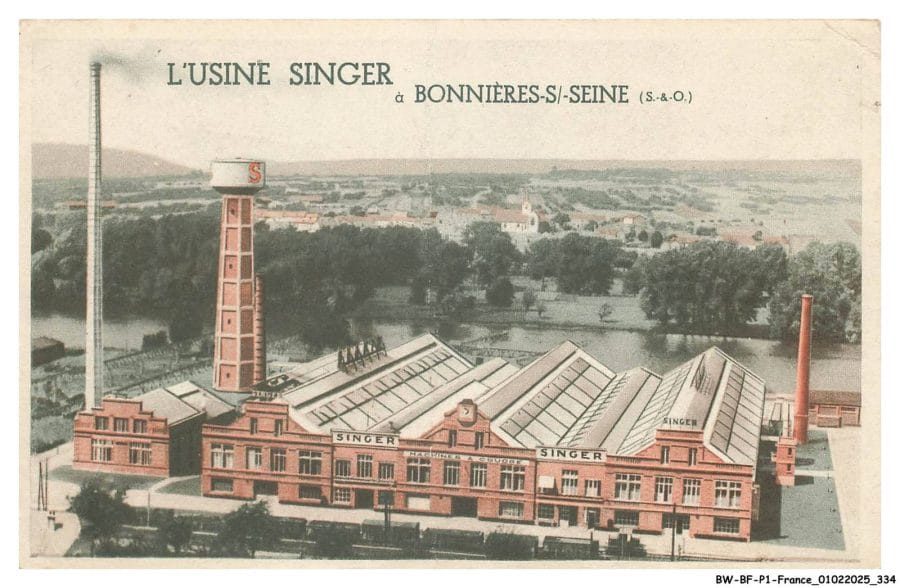
Sewing machines made in Bonnières Sur Seine (France)
Serial numbers of Singer sewing machines produced in Bonnières Sur Seine can be identified by their prefix letter.
They start with SA, SB, SC, and so on, until SN, followed by six digits.
Model numbers, instead, bear the location code B.
Showing 187 of 187 serial numbers
| Serial Number | Model | Year allotted | Notes |
|---|---|---|---|
| SA004050 | 15B88 | 1935-1986 | |
| SA005817 | 15B88 | 1937 | This machine has its original delivery receipt from July 31st, 1937 |
| SA008737 | 15B88 | 1935-1986 | |
| SA009659 | 15B88 | 1935-1986 | |
| SA010648 | 15B88 | 1935-1986 | |
| SA013422 | 15B88 | 1935-1986 | |
| SA014180 | 15B | 1935-1986 | |
| SA024414 | 15B88 | 1935-1986 | Decals: Eye and Trefoils. |
| SA025481 | 15B88 | 1935-1986 | |
| SA029666 | 15B88 | 1935-1986 | |
| SA094065 | 15B89 | 1935-1986 | |
| SA096700 | 15B88 | 1935-1986 | |
| SA106481 | 15B88 | 1935-1986 | |
| SA127195 | 15B88 | 1940 | The machine came with a purchase invoice dated 2nd May 1940. |
| SA127377 | 15B88 | 1935-1986 | Decals: Eye and Trefoils. |
| SA137692 | 15B88 | 1935-1986 | |
| SA138516 | 15B | 1935-1986 | |
| SA172714 | 15B88 | 1935-1986 | |
| SA181820 | 15B88 | 1935-1986 | |
| SA197901 | 15B88 | 1935-1986 | |
| SA226599 | 15B90 | 1935-1951 | Decals: Eye and Trefoils. About the machine (in French) |
| SA227163 | 15B88 | 1935-1986 | |
| SA228676 | 15B88 | 1935-1986 | |
| SA241162 | 15B90 | 1935-1986 | |
| SA250943 | 15B88 | 1935-1986 | |
| SA258170 | 15B88 | 1935-1986 | |
| SA259769 | 15B88 | 1935-1986 | |
| SA275428 | 15B90 | 1935-1986 | |
| SA290693 | 15B88 | 1951 | This machine has its original Certificate of Guarantee from 1951. |
| SA297461 | 15B88 | 1935-1986 | Decals: Eye and Trefoils. |
| SA312253 | 15B88 | 1935-1986 | Decals: Eye and Trefoils. |
| SA312486 | 15B | 1935-1986 | |
| SA320325 | 15B88 | 1961 | This machine has its original Certificate of Guarantee from the 25th May 1961. |
| SA321729 | 15B90 | 1950 | This machine has its original Certificate of Guarantee from 25th November 1950. |
| SA331235 | 15B88 | 1935-1986 | |
| SA333927 | 15B88 | 1935-1986 | |
| SA334742 | 15B88 | 1935-1986 | |
| SA339744 | 15B88 | 1949-1952 | This machine has the Centennial badge, commemorating 100 years of Singer in 1950, so we can assume it was manufactured around that period. |
| SA350095 | 15B90 | 1953 | The machine came with a purchase invoice dated 1953. |
| SA352922 | 15B88 | 1949-1952 | This machine has the Centennial badge, commemorating 100 years of Singer in 1950, so we can assume it was manufactured around that period. |
| SA355331 | 15B88 | 1951 | This machine has its original delivery note and Certificate of Guarantee from 1951. |
| SA356289 | 15B88 | 1935-1986 | |
| SA358501 | 15B88 | 1949-1952 | This machine has the Centennial badge, commemorating 100 years of Singer in 1950, so we can assume it was manufactured around that period. |
| SA367219 | 15B88 | 1949-1952 | This machine has the Centennial badge, commemorating 100 years of Singer in 1950, so we can assume it was manufactured around that period. |
| SA390693 | 15B88 | 1951 | This machine has its original warranty slip dated 1951. |
| SA400707 | 15B88 | 1949-1952 | This machine has the Centennial badge, commemorating 100 years of Singer in 1950, so we can assume it was manufactured around that period. |
| SA409042 | 15B90 | 1935-1986 | |
| SA413908 | 15B88 | 1935-1986 | |
| SA421853 | 15B88 | 1935-1986 | |
| SA422440 | 15B88 | 1952 | The machine came with a purchase invoice dated 19th August 1952. |
| SA428687 | 15B88 | 1952 | The machine came with its purchase year annotated (1952). |
| SA434798 | 15B88 | 1935-1986 | |
| SA435496 | 15B88 | 1935-1986 | |
| SA477130 | 15B88 | 1935-1986 | |
| SA484817 | 15B88 | 1935-1986 | |
| SA487336 | 15B88 | 1953 | This machine has its original purchase invoice and Certificate of Guarantee from 1953. |
| SA493885 | 15B88 | 1953 | This machine has its original purchase invoice dated 10th April 1953. |
| SA496765 | 15B88 | 1954 | Machine originally bought in 1954 in France. |
| SA500973 | 15B90 | 1935-1986 | |
| SA503583 | 15B88 | 1935-1986 | |
| SA509748 | 15B88 | 1935-1986 | |
| SA511761 | 15B88 | 1935-1986 | |
| SA512589 | 15B88 | 1935-1986 | |
| SA557205 | 15B88 | 1954 | This treadle machine has the original buying certificate from 1954. |
| SA557206 | 15B90 | 1935-1986 | |
| SA558121 | 15B90 | 1935-1986 | |
| SA558122 | 15B | 1935-1986 | |
| SA562818 | 15B90 | 1935-1986 | |
| SA565170 | 15B88 | 1935-1986 | |
| SA571324 | 15B88 | 1935-1986 | |
| SA573855 | 15B90 | 1935-1986 | |
| SA582483 | 15B | 1935-1986 | Decals: Eye and Trefoils. Photos of the machine |
| SA583350 | 15B90 | 1935-1986 | |
| SA587264 | 15B88 | 1954 | This machine has its original delivery note and warranty slip dated 6th November 1954. |
| SA588684 | 15B90 | 1935-1986 | |
| SA592777 | 15B88 | 1954 | This machine has its original purchase invoice and warranty slip from 1954. |
| SA602449 | 15B75 | 1935-1986 | |
| SA614307 | 15B75 | 1935-1986 | Original owner bought it new from the Singer shop in Noisy Le Sec (France), sold by a representative called M. Briant. Came with wooden cabinet and travelling box. |
| SA617483 | 15B75 | 1935-1986 | |
| SA617912 | 15B75 | 1935-1986 | |
| SA668516 | 15B75 | 1956 | The machine came with a purchase invoice dated 12th May 1956. |
| SA673991 | 15B75 | 1955 | The machine came with a purchase invoice from 1955. |
| SA674323 | 15B90 | 1935-1986 | |
| SA684162 | 15B75 | 1935-1986 | |
| SA688077 | 15B88 | 1935-1986 | |
| SA714066 | 15B75 | 1935-1986 | |
| SA714566 | 1935-1986 | More info on the factory | |
| SA732098 | 15B | 1935-1986 | |
| SA735119 | 15B75 | 1935-1986 | |
| SA735291 | 15B75 | 1935-1986 | |
| SA752218 | 15B | 1935-1986 | |
| SA760647 | 15B75 | 1956 | The machine came with a purchase invoice and Certificate of Guarantee from 1956. |
| SA764140 | 15B | 1935-1986 | |
| SA767381 | 15B75 | 1956 | The machine came with a purchase invoice from 1956. |
| SA799197 | 15B | 1935-1986 | |
| SA824103 | 15B | 1935-1986 | Color beige |
| SA824500 | 15B75 | 1935-1986 | |
| SA825818 | 15B11 | 1935-1986 | Color beige |
| SA831099 | 15B75 | 1935-1986 | |
| SA835600 | 15B75 | 1935-1986 | |
| SA880017 | 15B75 | 1935-1986 | |
| SA886986 | 15B90 | 1935-1986 | |
| SA908023 | 191B11 | 1935-1986 | |
| SA916083 | 191B11 | 1935-1986 | The machine came with an accessory box dated April 1957. A clue about the machine's dating, but the box could have been purchased separately, so be older or more recent than the machine itself. |
| SA922636 | 191B11 | 1935-1986 | |
| SA930211 | 191B | 1935-1986 | Tan color |
| SA937107 | 191B11 | 1935-1986 | |
| SA938010 | 191B | 1935-1986 | |
| SA939166 | 191B | 1935-1986 | |
| SA942576 | 191B | 1935-1986 | |
| SA945678 | 191B | 1935-1986 | Beige treadle machine with lamp |
| SA950882 | 191B | 1935-1986 | |
| SA965343 | 191B | 1935-1986 | |
| SA967590 | 191B | 1935-1986 | |
| SA971365 | 191B | 1935-1986 | |
| SA972842 | 191B | 1935-1986 | |
| SA976957 | 191B | 1935-1986 | |
| SA979173 | 191B | 1935-1986 | |
| SA979178 | 191B | 1935-1986 | Decals: Eye and Trapezoids. About the machine (in French) |
| SA979249 | 191B11 | 1935-1986 | |
| SA979478 | 191B | 1935-1986 | |
| SA982477 | 15B88 | 1935-1986 | Decals: Eye and Trefoils. More info on the factory |
| SA997364 | 191B | 1935-1986 | |
| SA998730 | 191B11 | 1935-1986 | The machine came with an accessory box dated 1958. A clue about the machine's dating, but the box could have been purchased separately, so be older or more recent than the machine itself. |
| SA999351 | 191B | 1935-1986 | |
| SA1000000 | 191B11 | 1935-1986 | Beige machine. Photo of the red logo badge |
| SB001055 | 191B | 1935-1986 | |
| SB012753 | 191B | 1935-1986 | |
| SB013533 | 191B11 | 1935-1986 | |
| SB028402 | 191B11 | 1935-1986 | |
| SB042743 | 191B11 | 1935-1986 | |
| SB044530 | 191B11 | 1935-1986 | |
| SB048086 | 191B11 | 1935-1986 | Color beige |
| SB052522 | 191B11 | 1935-1986 | Color beige |
| SB074229 | 191B | 1935-1986 | |
| SB087977 | 191B | 1935-1986 | |
| SB109315 | 191B17 | 1935-1986 | |
| SB115100 | 191B17 | 1935-1986 | Color beige |
| SB132494 | 191B | 1935-1986 | Color beige |
| SB132543 | 191B | 1935-1986 | |
| SB132547 | 191B | 1935-1986 | Color beige |
| SB133519 | 191B17 | 1935-1986 | Color beige |
| SB148812 | 191B17 | 1935-1986 | |
| SB158185 | 191B | 1935-1986 | |
| SB186687 | 191B17 | 1935-1986 | Color beige |
| SB195000 | 191B | 1935-1986 | |
| SB198582 | 191B17 | 1961 | This machine has its original Certificate of Guarantee and buying receipt from 21st February 1961. |
| SB202925 | 191B | 1935-1986 | |
| SB217492 | 191B | 1935-1986 | |
| SB221696 | 191B11 | 1935-1986 | Color beige |
| SB272778 | 191B | 1935-1986 | |
| SB299329 | 169B | 1935-1986 | |
| SB300370 | 191B | 1935-1986 | |
| SB313293 | 191B | 1935-1986 | |
| SB318255 | 191B17 | 1962 | This machine has its original Certificate of Guarantee from 28th February 1962. The serial number is SB318255, but the certificate reports SN318255. |
| SB330528 | 191B | 1935-1986 | |
| SB336452 | 191B | 1935-1986 | |
| SB348115 | 191B17 | 1935-1986 | |
| SB368867 | 191B17 | 1935-1986 | |
| SB374489 | 191B17 | 1935-1986 | |
| SB377820 | 191B11 | 1935-1986 | |
| SB381771 | 191B11 | 1935-1986 | |
| SB389557 | 169B | 1935-1986 | |
| SB399507 | 198B | 1935-1986 | |
| SB405191 | 191B11 | 1935-1986 | |
| SB406852 | 191B | 1935-1986 | |
| SB414435 | 191B11 | 1935-1986 | Color beige |
| SB415989 | 169B | 1962 | This machine has its purchase invoice from 1962. |
| SB435151 | 169B | 1935-1986 | |
| SB443970 | 169B | 1935-1986 | |
| SB447103 | 191B | 1935-1986 | |
| SB447262 | 169B | 1935-1986 | |
| SB452523 | 191B11 | 1935-1986 | Color beige |
| SB464483 | 191B | 1935-1986 | Color beige |
| SB471783 | 169B | 1935-1986 | |
| SB478921 | 191B | 1935-1986 | |
| SB661196 | 169B | 1935-1986 | |
| SB680215 | 169B | 1935-1986 | |
| SB680561 | 169B | 1935-1986 | |
| SB690920 | 198B | 1935-1986 | |
| SB699073 | 197B | 1935-1986 | Color beige |
| SB710516 | 198B | 1935-1986 | |
| SB773186 | 198B | 1935-1986 | |
| SB796491 | 198B | 1935-1986 | |
| SB1000000 | 191B13 | 1960 | The machine came with its original buying receipt dated 5th December 1960. |
| SC119037 | 128B | 1935-1986 | Decals: La Vencedora. |
| SM756250 | 191B | 1935-1986 |
Decals recorded in the factory of Bonnières Sur Seine
Here are the decal sets recorded in the factory of Bonnières Sur Seine, with their periods of use and the classes (models) they were applied to.
It’s a cross-reference of known Singer decal sets with the serial numbers in our own database. This may be helpful to date machines when serial records are incomplete.
Use recorded from 1955 to 1968
Documented machines in this factory
(What does it mean?)Total documented machines: 1
Documented Classes:
- 191

Use recorded from 1921 to 1955
This decal is sometimes called also "Triplets". Commonly used on 15-class machines. We recorded also a couple 66-class with these decals, but it could be a later application of decals on an older machine. Those 66 models were manufactured two decades before the patent for the Trefoil decals was filed. We also recorded a few 24-18 machine with Eye and Trefoils decal, produced before the 1931 patent for this decoration was files. It's indeed possible the patent was filed after the set had been used in production batches. Notice that the patents, while not mentioning specific models, seem to picture class 15 machines or similar.
Documented machines in this factory
(What does it mean?)Total documented machines: 7
Documented Classes:
- 15

Use recorded from 1902 to 1960
The name means "The Victrix"
Documented machines in this factory
(What does it mean?)Total documented machines: 1
Documented Classes:
- 128

Brief history of the Singer sewing machine factory in Bonnières Sur Seine

Singer’s French history took a major step forward in the 1930s. In October 1934, the company acquired the premises of the Leroy works in Bonnières-sur-Seine, a small industrial town northwest of Paris. The site already had a long industrial past, with links to both the Micheaux oil refinery and the St-Eloi metallurgical works.
According to the detailed BASIAS (“Base de données des Anciens Sites Industriels et Activités de Service”) inventory for the site, the new owner obtained its first official déclaration de fabrique on 28th May 1935, authorising the production of sewing machines and the associated metalworking, woodworking and enamelling activities.
Singer inaugurated its new French plant in 1935, under the name La Compagnie Singer Société Anonyme. The Bonnières plant required more renovation and expansion before reaching its full production potential: an authorisation, issued on 20th November 1936, approved major extensions to the workshops. Unlike smaller assembly facilities elsewhere, Bonnières was a vertically integrated factory: it could handle every step of sewing machine production, from castings and enamel finishing to the making of wooden cases and even electric motors. At its peak, more than 1600 workers were employed there.
The factory was ideally placed between the Seine and the Paris–Le Havre railway, with direct access to river transport and a private rail spur. This strategic location allowed raw materials to arrive efficiently and finished machines to be shipped across France and beyond. For decades, the brick-red buildings of the Singer plant dominated the townscape and became closely tied to Bonnières’ identity.
Machines produced here carried a “B” after the model number (such as the 15B or 191B) and serial numbers beginning with two letters SA, SB, SC, and so on, followed by six digits. These markings remain the clearest way to identify a Bonnières-made Singer today.
Through the 1950s and 1960s, Bonnières was an important part of Singer’s global network. But by the late 1960s, traditional family sewing machines were phased out, and the factory began winding down. In 1971 the plant passed under Singer France SA, continuing production on a smaller scale. Ultimately, facing global competition and rising costs, the site closed in 1985.
Today, most of the factory complex has been repurposed as a business park, with only one original building preserved in its early form.

A closer look inside the Bonnières factory

A fascinating description of the Bonnières plant was published at the beginning of the 1950s in Visite à l’usine de Bonnières-sur-Seine. It gives us a vivid picture of how Singer machines were actually made there, and of the scale and precision involved.
Berget describes Bonnières as a fully integrated plant: it manufactured nearly every component of a sewing machine, from the iron castings to the enamel finish, from wooden cabinets to electric motors. Strict quality checks were carried out at every stage, ensuring Singer’s reputation for durability and precision.
The production process began in the foundry, where molten iron was poured into sand molds to form the machine’s key parts. These raw castings were then machined into the two main elements of a sewing machine’s “head”: the arm and the bed. Each operation (drilling, milling, threading, fitting) was checked again and again to guarantee accuracy.
After machining, the parts were smoothed, polished, and cleaned before entering the enameling department. Here, the heads were coated, dipped and sprayed with multiple layers of enamel, then decorated with decals and finished with a clear varnish. The machines were left to cure for four weeks to ensure a lasting shine.
Assembly brought everything together: the heads were fitted with hundreds of precisely engineered parts, then tested for function and adjusted by skilled workers. Each machine was run through sewing trials, including embroidery and darning, before being oiled, polished, and packed for shipping. Berget notes that a finished Singer machine contained no fewer than 204 individual parts.
The Bonnières plant also had large woodworking shops where cabinets and cases were made from timber that had been carefully seasoned, both outdoors and in kilns. And alongside the sewing machines, the factory produced Singer’s own electric motors, held to the same strict standards of quality and endurance.


Beyond production, Singer placed emphasis on worker welfare: modern canteens, medical services, bus transportation, and social facilities were provided, echoing the company’s broader tradition of creating community around its factories.
By the late 1960s, however, the production of family sewing machines at Bonnières came to an end, and the factory gradually wound down before closing entirely in the 1970s. Today, only part of the site remains, repurposed for new industries, but Berget’s account preserves a detailed glimpse of the factory’s heyday.
Bonnières remembered today
Even though the Singer factory in Bonnières-sur-Seine closed in the late 1970s, the site continues to draw attention as an important part of local and industrial heritage.
In 2010, during the Journées du Patrimoine, Odile Berget visited the old plant and described what survives.
Most of the factory buildings have since been repurposed as a business park, but one structure remains as it was: the steam engine hall. The massive Farcot steam engine, dating from 1906 (before Singer acquired the site), has been restored by a group of volunteers. Although its boiler is no longer in service, the machinery can still run on compressed air. Visitors are struck by its sheer scale, from the gigantic flywheels to the marble-backed electrical control panels that once powered the plant.
A former employee has also set up part of his personal collection of sewing machines there, and there are hopes that a small museum dedicated to Bonnières’ industrial past may eventually open.

Resources
- About the Singer factory of Bonnières sur Seine by SingerSewingInfo
- (FR) About the history of the factory
- French factory tour in the 1950s, in French and English
- Tour of the factory in 2010, in French and English
- The restored powerplant, in French and English
- (FR) The discussion forum that was the starting point of this research






)
6 Comments. Leave new
I have a 15B75 no SA614307. Came from son of original owner who bought it new from the Singer shop in Noisy le Sec. The représentative was a M. Briant. It came with the original instruction book which has your illustration of the factory. Lovely wooden cabinet and travelling box too.
Thank you so much! By chance, have you any idea of the period this machine was originally purchased? Thank you again!
My Singer 191B was a gift from my parents in 1961 – its serial number is SB217492.
I am assuming that it was born in Bonnières Sur Seine, but is this correct?
I have happily used it for years, making everything from lightweight blouses to my leather motorcycle suit.
Yes, a French machine indeed. I am happy you enjoy it! Thank you for sharing the serial number!
I have a Singer 128B hand crank machine which says Made in France. The serial number is stamped on the front lip under the base. At first, I thought it said C24457, but on closer examination, there is the letter S at the front and another numeral at the end – perhaps an 8. The S and 8 are fainter than the rest of the serial number marks. The middle of the base is stamped SINGER -B, 8450, II. I would appreciate any information you can share about this machine. Thank you.
Hello, thank you for reaching out to us. Would you mind sending photos, so we can help you verify the machine’s model? You can use our contact form. Thank you!