Following my broader researches about the Singer production in Monza (Italy) and Bonnières-sur-Seine (France), I’d like to share more about other key factories within the global network established by the Singer company.
My main goal is to connect that history with practical tools, cross-referencing factory locations, models, decals and other identifying features extracted from all the data I am carefully adding to my Singer serial number database. In doing so, I hope to give collectors and researchers more and more tools to identify and date their machines, especially in cases where serial numbers are not enough.
The thing about the Bridgeport factory is that its official serial number allocation records are lost, but a slide chart survived instead, offering valuable clues for dating the machines produced there.
Adding to this complexity, the factory’s early production included the 9W models, derived from Wheeler & Wilson Manufacturing Company designs. This factory was indeed born as a Wheeler & Wilson plant. Those 9W models used a numbering approach that does not follow the consistent and traceable serial system typically relied upon for Singer machines.
For this reason, I want to dedicate a specific space to Bridgeport and its machines, to help reconstruct a reliable history.

Table of contents
Serial prefixes, location codes, and production years
Here are the recorded factory identification details for Bridgeport: its location code, serial number prefixes and years of operation.
The location code is the letter found in the model number that identifies the manufacturing site of a particular machine. On the other end, serial prefixes are one or two letters at the beginning of the serial number that distinguish serial number ranges assigned to machines produced at different factories.
Brief history of the Bridgeport factory

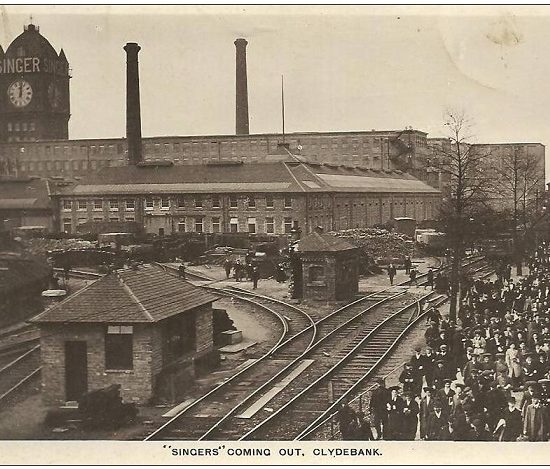
The Singer factory in Bridgeport (CT, USA) has its origins in 1856, when the Wheeler & Wilson Manufacturing Company relocated its operations from Waterbury to a larger site in this Connecticut town.
During the 1850s and 1860s, this factory expanded significantly alongside growing demand, eventually incorporating specialized facilities such as foundries, assembly shops, cabinet-making departments, and even a dedicated needle factory. In March 1973 the New York based publication “The Christian Weekly” published an interesting article “Sewing-Machines and How they are Made“: here the journalist reports of the visit he payed to the Bridgeport factory a few months earlier, in Autumn 1972.
Although production peaked in the early 1870s at around 128,000 machines annually, the company gradually declined as its rival, Singer Manufacturing Company, came to dominate the global market.
In 1905, Singer acquired Wheeler & Wilson and integrated the Bridgeport plant into its operations. After a transitional period producing rebranded Wheeler & Wilson machines, the factory became a major center for Singer’s industrial sewing machines, identifiable by their “W” model designation (such as 107W and 112W).
From contemporary books, magazines and historical records, it’s apparent that Singer was a company that cared for its employees, and many workers were proud of their employee. Singer has always provided many benefits for their workforce, and the Bridgeport factory was no exception. This factory had an employee newspaper, featuring also sections to sell various items or ask for rides to work. The factory even had a formal Manufacturer’s Chorus.
Employing around 1500 workers by 1949, the Bridgeport factory remained a key industrial hub until its closure in 1964, in a moment of broader decline of the sewing machine industry.
About the surviving Singer slide chart
Published online by active collectors and researchers, then shared with the world by ISMACS, this chart was originally designed as a practical, portable reference tool.
It has a sort of a sleeve-like pocket where you can slide in a a printed strip listing serial prefix letters, number ranges and their corresponding years of production. A cut-out window reveals one line at a time, allowing the user to align the scale and read an approximate production period.
A pretty handy tool for the time it was made! The closest equivalent to our own database I could imagine.
It shows a few serial number prefixes on the front side and the W-series on the back. This lets me suspect the chart was made by the Bridgeport factory, or to serve this factory production figures in the first place. This is just my own opinion, having that the chart itself only states “Made in the U.S.A.”. The instructions also carry another list of prefix letters that are specific for models having the location code K (indicating the Kilbowie factory in Scotland).
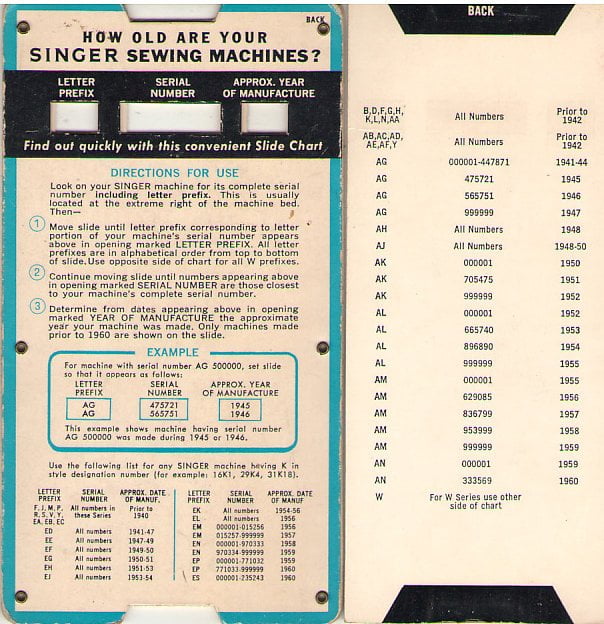
Singer serial number slide chart to date a machine by its serial number. Back side.
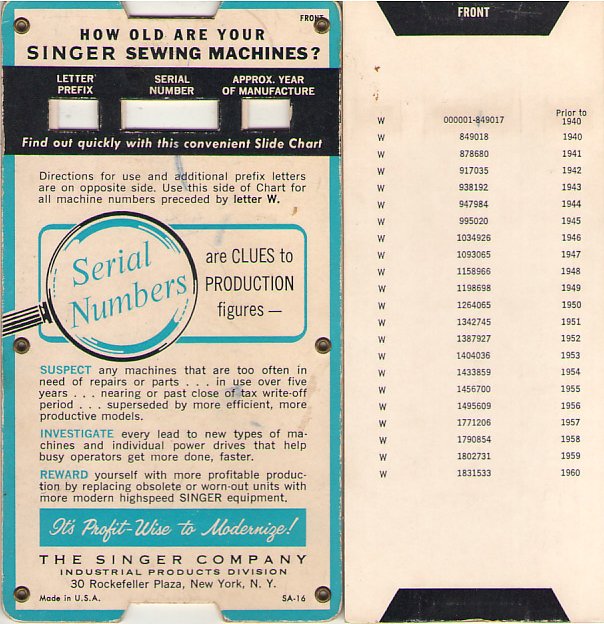
Singer serial number slide chart to date a machine by its serial number. Front side.
Decals from the Bridgeport-made sewing machines
Here are the decal sets recorded on machines made in the factory of Bridgeport, with their periods of use and the classes (models) they were applied to.
It’s a cross-reference of known Singer decal sets with the serial numbers in our own database. This may be helpful to date machines when serial records are incomplete.
Use recorded from 1905 to 1913
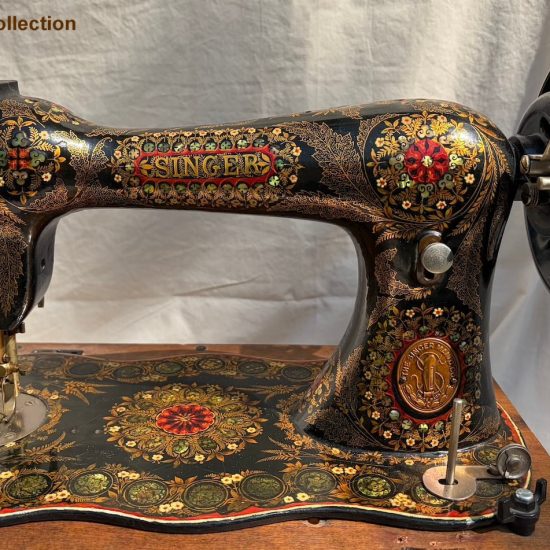
This decal set replaced the Wheeler and Wilson badging, after Singer spent a couple of years tweaking the Wheeler and Wilson W D9. This class of machines was produced between 1905 and 1913. Unfortunately, those machines have serial numbers that do not follow the Singer number system, and we don't have official records for them. We have been able to track a few of them.
Documented machines in this factory
(What does it mean?)Total documented machines: 73
Documented Classes:
- 9

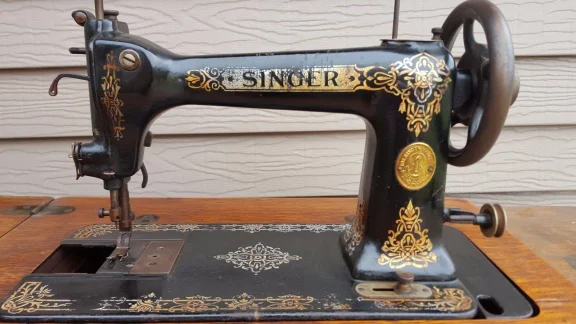
This decal set is typical of the Bridgeport factory. It is a variation of the Celtic Knot decal used in 9W machines produced by Singer in Bridgeport between 1905 and 1913, a model derived from the Wheeler and Wilson D9. More on Bridgeport factory.
Documented machines in this factory
(What does it mean?)Total documented machines: 1
Documented Classes:
- 51

Use recorded from 1884 to 1955
While most of the industrial models did not have decals, this one is probably the most common one used on industrial Singer machines. Variations depend largely on the shape of the specific machine. It may feature intricate leaf scrolls or just the ornate monogram "The S.M. Co." ("The Singer Manufacturing Company"). Also the position of each decorative element varies from model to model, due to the particular shapes of certain industrial machines.
Documented machines in this factory
(What does it mean?)Total documented machines: 3
Documented Classes:
- 12
- 21
- 72

Use recorded from 1886 to 1959
Also called “Egyptian” decals, they first appeared in the 1890’s. They were used on the class 15 and class 27 up to the 1950’s.
Documented machines in this factory
(What does it mean?)Total documented machines: 1
Documented Classes:
- 15
Documented years: 1950

Use recorded from 1954 to 1962
Documented machines in this factory
(What does it mean?)Total documented machines: 2
Documented Classes:
- 306
- 319
Documented years: 1956

Share info about your machine
If you happen to own a Singer sewing machine, feel free to get in touch and share your machine’s serial number (and photos, if you have them). Each one adds another piece to the puzzle. Please share what you know with the community! Thank you for helping us in this monumental research.
Classes from the Bridgeport-made sewing machines
Here are the classes recorded on machines made in the factory of Bridgeport, with their periods of use and the decals applied. The class is the core mechanism design (the base machine type), while the full model number combines that class with a factory code and a sub-version variant indicating specific features. For example, a model 15K88 is sub-version 88 of class 15, while “K” is the factory location code for Kilbowie.
It’s a cross-reference of the classes we associated to serial numbers in our own database. This may be helpful to date machines when serial records are incomplete.
9W
Use recorded from 1905 to 1913
9W machines are the continuation of Wheeler & Wilson D9 models, after Singer acquired the company and their Bridgeport plant in 1905. One of the most noticeable features of the 9W is its square-section pillar, that contrasts with the round pillars typical of Singer machines of the same period. More on the factory and the 9W machines
Documented machines in this factory
(What does it mean?)Total documented machines: 75
Documented Decals:
12
Use recorded from 1865
The Singer "New Family", introduced in 1865 and soon sold in the UK, was later renamed Singer 12. Early models, with their distinctive "fiddlebed" shape, used a transverse boat-shaped shuttle and round-shank "Class 12x1" needles. Later models had a rectangular base. From 1870 it was available for semi-industrial use with a longer arm, as the class 13. There are many industrial variants, like the 12K Industrial Free Arm.
Documented machines in this factory
(What does it mean?)Total documented machines: 1
Documented Decals:

15
Use recorded from 1879 to 1963
Successor to the "New Family", was the "Improved Family", which was given the class 15 designation. Originally patented by Singer engineer P. Diehl in 1878 (UK patent 2813, 13th July 1878), the 'Improved Family' was launched in 1879 as a treadle machine, lock stitch oscillating shuttle. It has the tension on the face plate. By the 1890s the name 'Improved Family' had been dropped and replaced by "Class 15". In the same period, the had received a serious upgrade. It had the most common domestic variant and also several industrial variants.
Documented machines in this factory
(What does it mean?)Total documented machines: 1
Documented Decals:
Documented years: 1950

21W
Use recorded up to 1948
Industrial machine for specialized uses, such as shirts, shirt waists, wrappers, corsets, underwear, overalls, duck coats, canvas, tailoring, gloves, shoes, slippers, awnings, flossing, etc.
Documented machines in this factory
(What does it mean?)Total documented machines: 1
Documented Decals:

35
Use recorded from 1900 to 1969
Two thread chain stitch industrial machines for stitching carpets. You hold it by the handle on the side and operate it by cranking the lever on the other side of the flywheel, to stitch two rolls of carpet together.
Documented machines in this factory
(What does it mean?)Total documented machines: 7
Documented years: 1947 - 1959

47
Use recorded from 1900 to 1969
Industrial lock stitch machines with cylinder bed. One needle and belt driven rotary sewing hook. Used for stitching tubular, concave or other irregularly shaped articles in cloth or leather.
Documented machines in this factory
(What does it mean?)Total documented machines: 2
Documented years: 1928

51W
Use recorded up to 1961
Industrial machines for tailoring or for stitching shoes and lightweight leather. Single needle post bed machines.
Documented machines in this factory
(What does it mean?)Total documented machines: 1
Documented Decals:

61
Industrial machines for lockstitch at high speed in fabrics and light leather work.
Documented machines in this factory
(What does it mean?)Total documented machines: 3
Documented years: 1940

65
Industrial machines for for tubular work.
Documented machines in this factory
(What does it mean?)Total documented machines: 1

71
Industrial buttonholer machines. Designed for automatically making straight buttonholes, with the purl or whip stitch, and with or without barred ends according to the description of each specific model (except 71-47).
Documented machines in this factory
(What does it mean?)Total documented machines: 1
Documented years: 1950

72
A group of industrial machines. We know of the 72W19 for two-needle hemstitching, or the 72W12 double-needle for vamping and shoe work. Serial number records for Elizabethport register 106 72-class machines.
Documented machines in this factory
(What does it mean?)Total documented machines: 9
Documented Decals:

82
Use recorded from 1906 to 1965
Industrial glove-makers machines, two-thread chain stitch.
Documented machines in this factory
(What does it mean?)Total documented machines: 1
Documented years: 1945

107W
Industrial machines for high speed zigzag lock stitching.
Documented machines in this factory
(What does it mean?)Total documented machines: 4
Documented years: 1948

108W
Use recorded from 1914 to 1968
Industrial lock stitch machines with unison feed. It's not clear if there are differences between the 108W and 108K for lack of documentation and surviving machines.
Documented machines in this factory
(What does it mean?)Total documented machines: 1
Documented years: 1955

109W
Industrial high speed tailoring machines.
Documented machines in this factory
(What does it mean?)Total documented machines: 1
111
Use recorded from 1942 to 1959
Single needle industrial lock stitch machines. For stitching medium and heavy fabrics, canvas, leather. After a small batch of 25 machines in 1915, serial number allotments resume in 1942.
Documented machines in this factory
(What does it mean?)Total documented machines: 7
Documented years: 1942 - 1959

112W
Industrial two-needle lock stitch machines.
Documented machines in this factory
(What does it mean?)Total documented machines: 1
Documented years: 1944

114W
Industrial single needle chain and drop stitch machines.
Documented machines in this factory
(What does it mean?)Total documented machines: 2

123W
Use recorded from 1905
Industrial lock stitch, vertical hook machines with cylinder bed. Known as "Needle Feed Short Horizontal Cylinder Machines" in the class manuals.
Documented machines in this factory
(What does it mean?)Total documented machines: 2

136W
Use recorded from 1946
Industrial post bed lock stitch, continuous wheel feed machines. For leather work, independently driven, oblique underedge trimmer.
Documented machines in this factory
(What does it mean?)Total documented machines: 1
Documented years: 1946

145W
Use recorded from 1943 to 1966
Industrial machines.
Documented machines in this factory
(What does it mean?)Total documented machines: 1
Documented years: 1943

150
Use recorded up to 1940
Industrial cylinder-arm sewing machine designed for stitching bulky materials, like coats and outdoor gear. Produced in a variety of arm lenghts.
Documented machines in this factory
(What does it mean?)Total documented machines: 1

153
Use recorded from 1950 to 1969
Industrial single needle lock stitch machines. Medium duty, cylinder arm.
Documented machines in this factory
(What does it mean?)Total documented machines: 1
Documented years: 1950

168
Use recorded from 1944
Industrial post bed machines. Lock stitch, single needle, compound feed.
Documented machines in this factory
(What does it mean?)Total documented machines: 1
Documented years: 1944

306
Use recorded from 1954 to 1962
Domestic zig-zag stitch, swing needle machines in aluminum. Allotted in serial number records from 1954 to 1962, except for the factory of Monza, whose original records are lost. Available in tan or black, with or without decals.
Documented machines in this factory
(What does it mean?)Total documented machines: 2
Documented Decals:
Documented years: 1956

319
Use recorded from 1956 to 1962
Domestic zig-zag machines, evolution of Class 306. Similar to Class 320, but flat bed, while Class 320 is tubular bed. Black with decals or colored (tan, green).
Documented machines in this factory
(What does it mean?)Total documented machines: 2
Documented Decals:
Documented years: 1956

Share info about your machine
If you happen to own a Singer sewing machine, feel free to get in touch and share your machine’s serial number (and photos, if you have them). Each one adds another piece to the puzzle. Please share what you know with the community! Thank you for helping us in this monumental research.
The Singer 9W, a continuation of Wheeler & Wilson 9 and D9
Singer 9W machines stand out among the other Singer models. This is because it began life not as a Singer design, but as the Model D9 produced by the Wheeler & Wilson Manufacturing Company. After Singer acquired Wheeler & Wilson in 1905, production of the D9 continued at the Bridgeport factory, but the machines were rebranded as Singer 9W.
Early 9W machines were mechanically identical to the original D9, likely reflecting Singer’s use of existing Wheeler & Wilson parts while determining the factory’s future. These early examples carried serial numbers with a “W” prefix.
One of the most immediately noticeable features of the 9W is its square-section pillar, in contrast to the round pillars typical of Singer machines of the period. This design would remain unique within the Singer range until the reappearance of square pillars decades later in the 239 in the 1960s.
As production continued under Singer management, the 9W was gradually modified to align more closely with standard Singer designs. The bed casting was enlarged and the hinges repositioned, allowing the machine to fit standard Singer cases, treadles and cabinets. These updated versions, the 9W7 models, abandoned the “W” prefix and instead used plain numeric serial numbers within the same sequence. Other changes included replacing the original Wheeler & Wilson fold-over spool frame on the arm with Singer’s more typical straight spool pin mounted near the balance wheel.
Production of the 9W7 ended around 1913, after which the Bridgeport factory focused exclusively on industrial machines.
The main issue with 9W models are those machines presenting a notable exception in Singer’s serial numbering system. Its plain numeric serials, without the W-prefix letter, likely follow the earlier Wheeler & Wilson format, as Singer had abandoned number-only serials by the year 1900 in favor of prefix letters. As a result, encountering a Singer machine without a prefix would normally suggest 19th-century production, but in the case of a 9W this assumption can be misleading. Without awareness of this model, it is easy to misdate these machines by several decades.
While Singer is generally known for its remarkably thorough record-keeping, most notably when compared to other manufacturers, the history and featurs of the 9W models create issues in historical research. For example, it remains unclear at what point Wheeler & Wilson decals were fully replaced by Singer Celtic Knot design (also known as Singer Pearl), typical of 9W models, or exactly when certain mechanical changes were introduced.
One such change is the shift from the original “bagel” (or donut-shaped) bobbin to a later style: a variant of the 9W shows a slightly larger bobbin, similar to that found in the Singer Featherweight 221. While Featherweight bobbins can generally be used in this version of the 9W, the reverse is not recommended due to this slight size difference. Surviving machines suggest that these developments did not occur all at once, but overlapped in ways that defy a simple timeline.
This overlap is particularly evident in machines that combine features we would not necessarily expect to see together. For example, some later 9W7 machines, already updated with Singer-standard bed dimensions to fit interchangeable cabinets and treadles, still retain the earlier Wheeler & Wilson-style bobbin. Based on currently known examples, such machines likely date to a narrow window around 1909–1911, though this remains an informed estimate rather than a confirmed range.
Ultimately, the 9W highlights both the strengths and the limits of Singer research. Even with a company known for its detailed records, gaps remain, and we are here to help close them.

Share info about your machine
If you happen to own a 9W or a Wheeler & Wilson D9, feel free to get in touch and share your machine’s serial number (and photos, if you have them). Each one adds another piece to the puzzle. Please share what you know with the community! Thank you for helping us in this monumental research.
The Singer 9W serial numbers we verified so far
Here are the 9W class sewing machines made in Bridgeport we encountered so far. Please, if you know others let us know!
The Bridgeport factory produced other classes, but here we concentrate just on 9W machines, because of their peculiar serial numbers. Feel free to use our main database to look into other Bridgeport-made serials!
| Serial Number | Model | Year allotted | Notes |
|---|---|---|---|
| 3099627 | 9W | 1905-1913 | Decals: Celtic Knot (or Singer Pearl). |
| 3114823 | 9W | 1905-1913 | Decals: Celtic Knot (or Singer Pearl). |
| 3120746 | 9W7 | 1911-1913 | Decals: Celtic Knot (or Singer Pearl). |
| 3122206 | 9W7 | 1911-1913 | Decals: Celtic Knot (or Singer Pearl). D9-style bobbin |
| 3127543 | 9W | 1905-1913 | Decals: Celtic Knot (or Singer Pearl). 301-style bobbin |
| 3130170 | 9W | 1905-1913 | Decals: Celtic Knot (or Singer Pearl). |
| 3136048 | 9W | 1905-1913 | Decals: Celtic Knot (or Singer Pearl). |
| 3136261 | 9W | 1905-1913 | |
| 3137194 | 9W | 1905-1913 | Decals: Celtic Knot (or Singer Pearl). |
| 3140411 | 9W | 1905-1913 | Decals: Celtic Knot (or Singer Pearl). |
| 3140621 | 9W7 | 1911-1913 | Decals: Celtic Knot (or Singer Pearl). |
| 3142201 | 9W | 1905-1913 | Decals: Celtic Knot (or Singer Pearl). |
| 3144259 | 9W | 1905-1913 | Decals: Celtic Knot (or Singer Pearl). |
| 3144341 | 9W | 1905-1913 | Decals: Celtic Knot (or Singer Pearl). |
| 3150557 | 9W | 1905-1913 | Decals: Celtic Knot (or Singer Pearl). |
| 3150562 | 9W | 1905-1913 | Decals: Celtic Knot (or Singer Pearl). |
| 3151342 | 9W | 1905-1913 | Decals: Celtic Knot (or Singer Pearl). |
| 3151727 | 9W | 1905-1913 | Decals: Celtic Knot (or Singer Pearl). |
| 3155410 | 9W | 1905-1913 | Decals: Celtic Knot (or Singer Pearl). |
| 3155936 | 9W | 1911-1913 | Decals: Celtic Knot (or Singer Pearl). |
| 3157691 | 9W | 1905-1913 | Decals: Celtic Knot (or Singer Pearl). |
| 3158880 | 9W | 1905-1913 | Decals: Celtic Knot (or Singer Pearl). |
| 3161253 | 9W | 1905-1913 | Decals: Celtic Knot (or Singer Pearl). |
| 3163007 | 9W | 1905-1913 | Decals: Celtic Knot (or Singer Pearl). |
| 3164697 | 9W | 1905-1913 | Decals: Celtic Knot (or Singer Pearl). |
| 3168005 | 9W | 1905-1913 | Decals: Celtic Knot (or Singer Pearl). |
| 3168315 | 9W1 | 1905-1913 | Decals: Celtic Knot (or Singer Pearl). |
| 3170520 | 9W | 1905-1913 | Decals: Celtic Knot (or Singer Pearl). |
| 3170791 | 9W | 1905-1913 | Decals: Celtic Knot (or Singer Pearl). |
| 3171825 | 9W | 1905-1913 | Decals: Celtic Knot (or Singer Pearl). |
| 3177929 | 9W | 1905-1913 | Decals: Celtic Knot (or Singer Pearl). |
| 3178797 | 9W | 1905-1913 | Decals: Celtic Knot (or Singer Pearl). |
| 3180035 | 9W7 | 1911-1913 | Decals: Celtic Knot (or Singer Pearl). |
| 3190359 | 9W | 1905-1913 | Decals: Celtic Knot (or Singer Pearl). |
| 3190970 | 9W7 | 1911-1913 | Decals: Celtic Knot (or Singer Pearl). |
| 3193418 | 9W | 1905-1913 | Decals: Celtic Knot (or Singer Pearl). |
| 3193765 | 9W | 1905-1913 | Decals: Celtic Knot (or Singer Pearl). |
| 3201465 | 9W | 1905-1913 | Decals: Celtic Knot (or Singer Pearl). |
| 3202267 | 9W | 1905-1913 | Decals: Celtic Knot (or Singer Pearl). |
| 3206045 | 9W | 1905-1913 | Decals: Celtic Knot (or Singer Pearl). |
| 3210059 | 9W | 1905-1913 | Decals: Celtic Knot (or Singer Pearl). |
| 3211560 | 9W | 1905-1913 | Decals: Celtic Knot (or Singer Pearl). |
| 3213593 | 9W | 1905-1913 | Decals: Celtic Knot (or Singer Pearl). |
| 3213766 | 9W | 1905-1913 | Decals: Celtic Knot (or Singer Pearl). |
| 3216681 | 9W | 1905-1913 | Decals: Celtic Knot (or Singer Pearl). |
| 3217294 | 9W | 1905-1913 | Decals: Celtic Knot (or Singer Pearl). |
| 3217593 | 9W | 1905-1913 | Decals: Celtic Knot (or Singer Pearl). |
| 3217953 | 9W | 1905-1913 | Decals: Celtic Knot (or Singer Pearl). |
| 3220806 | 9W7 | 1911-1913 | |
| 3220908 | 9W | 1905-1913 | Decals: Celtic Knot (or Singer Pearl). |
| 31316381 | 9W | 1905-1913 | Decals: Celtic Knot (or Singer Pearl). |
| 31670791 | 9W | 1905-1913 | Decals: Celtic Knot (or Singer Pearl). |
Resources
- History of Singer Bridgeport factory
- Working for Singer
- Singer 9W models
- The Needlebar about the Singer 9W
- “Sewing-Machines and How they are Made“, article from 1873 about a visit to Bridgeport factory
- On the history of Singer company
- Complete database of vintage Singer sewing machines serial numbers, plus info about serial numbers, factories and location codes, class and model numbers
- Singer sewing machine manuals
- Singer sewing machine decal sets