Some Singer factories are easier than others to research: there are factory records, books, photographs, plenty of machines to examine, even videos. Others are much more difficult, with most of the documents lost to us.
The Singer factory of Wittenberge in Germany is one of those difficult yet fascinating cases. But there’s some exciting news for anyone interested in these machines: thanks to the generosity of German researcher Uwe, who has spent years studying the factory, we’re now able to go much further in understanding its history and identifying the machines it produced. And, even better, he is offering to help owners identify their own Wittenberge Singer machines!
While researching Singer machines and their serial numbers, I had the pleasure of getting to know Uwe. His approach is exactly the kind of research I find so valuable: he goes back to the original documents and tries to put all the pieces together.
He has collected and evaluated an extraordinary amount of original material from Wittenberge, including original invoices, control cards, delivery documents and operating instructions. He has also tracked down original patents for machines such as the Singer 206, 103 and 201, and researched the wider economic and historical circumstances surrounding the factory. Thousands of machines are now part of his huge documentation effort.
This is particularly important when trying to understand what surviving Singer machines can tell us via their serial numbers. This research about Wittenberge shows just how complicated the relationship between production, sales and surviving paperwork can become.
For example, Singer sold machines in Germany (and elsewhere) through hire purchase. During the difficult years between the end of World War I and the 1930s, some customers were unable to complete their payments and machines were returned to Singer. Some of these machines were then refurbished and sold again. And refurbishment complicates dating. For anyone trying to date surviving machines from sales documents, a later invoice may not necessarily mean that the machine itself was newly produced at that time.
Uwe has been working through these complications by comparing serial numbers with original invoices, prices, payment histories, manuals, needle charts and other dated material. He also treats the different Singer model classes separately when establishing production dates, rather than assuming that evidence from one class can automatically be applied to another.
There is another fascinating aspect to the story as well: the factory did not exist in isolation, as we learnt for other plants like Bridgeport or Elizabethport. Inflation, wars, economic crises, the German sewing machine industry and Singer’s relationships with suppliers and customers all affected what happened at Wittenberge.
Thanks to Uwe’s generosity in sharing his carefully collected research with me, we can have a reliable indication of dates and production figures, to which I can add my own piece of the puzzle. I can cross-reference his data with the documented machines and serial number records I am collecting, to go deep into the decals and classes that came out of Wittenberge.
A huge thank you to Uwe for his monumental research, for sharing his years of research and original documentation, and for being willing to help other Singer enthusiasts with their machines. Putting all those pieces together is no small task. I’m delighted to be able to make this connection between his research and the community.
A unique opportunity for Wittenberge machine owners
This page is also the starting point of a collaborative research project.
If you own a Singer machine made in Wittenberge, you can now get in touch with Uwe directly. By submitting photographs and the machine’s serial number through the dedicated form, you can ask him to examine your machine and provide his expert assessment of its age, model and other relevant details.
This is a particularly valuable opportunity: Uwe can draw on his original documentation, years of research and knowledge of the factory to help make sense of individual machines. And every new identification can contribute to a better understanding of Wittenberge production.
The full research will be published more extensively through ISMACS in the next weeks, but this page is where you can already discover the research before the official pubblication, learn about its findings and, most importantly, contact Uwe directly for help in identifying your machine.
Ask the expert to identify your machine
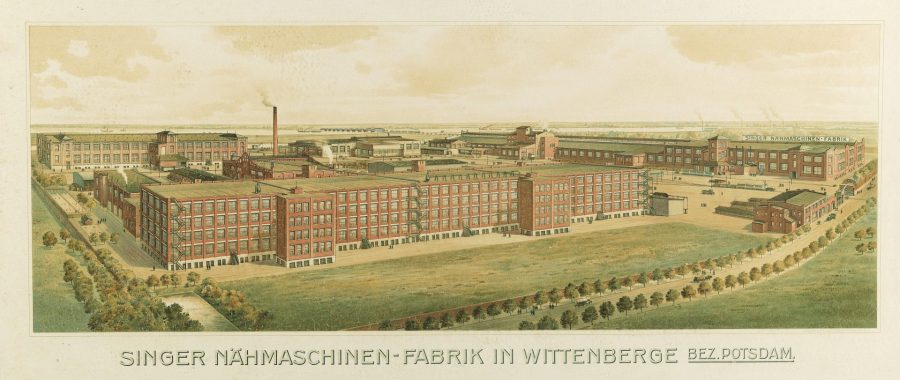
Table of contents
Serial prefixes, location codes and production years
Here are the recorded factory identification details for Wittenberge: its location code, serial number prefixes and years of operation.
The location code is the letter found in the model number that identifies the manufacturing site of a particular machine. On the other end, serial prefixes are one or two letters at the beginning of the serial number that distinguish serial number ranges assigned to machines produced at different factories.
Wittenberge, Prussia (Germany)
Active from 1904 to 1946
Country: Germany
City: Wittenberge, Prussia
Plant location: Bad Wilsnacker Straße 48, Wittenberge, Germany
Location code: D
Serial number prefixes:
- C
Documented machines for this factory: 60
Documented decals applied in this factory: 6
Documented classes in this factory: 8

Find out info about your machine
If you happen to own a Singer sewing machine, feel free to get in touch and share your machine’s serial number and photos. We’ll help you date and identify it, and add another piece to the Wittenberge puzzle. Thank you for helping us in this monumental research.
Brief history of the Wittenberge factory

The history of Singer in Germany began at the end of the 19th century, before the Wittenberge factory was built. In 1856, Georg Neidlinger emigrated from Germany to the United States, where he found employment with the Singer Manufacturing Company in New York in 1857. In 1860, Singer appointed him to organize its sales network in Central Europe. He returned to Europe and played an important role in establishing Singer’s commercial presence across the continent.
Georg Neidlinger subsequently became a central figure in Singer’s German operations. In 1885 he settled an office and warehouse in Hamburg and later, in 1895, founded the Singer NähmaschinenAktiengesellschaft company, which became Singer’s principal German sales organization.
At the beginning of the 20th century, Wittenberge was already developing rapidly into an important industrial town. Its location was particularly favorable for this: the town stood on the Elbe and Stepenitz rivers and, since 1847, had been an important railway junction. These connections made Wittenberge an attractive place for industry, and around the turn of the century the town was experiencing a period of rapid economic growth.
It was in this setting that Singer decided to establish a manufacturing plant. The Singer factory in Wittenberge was founded in 1903. The factory was built as part of Singer’s expansion to supply the European market, and Wittenberge soon became one of the company’s major manufacturing centers. The city would eventually become so closely associated with sewing machines that it became known as “the city of sewing machines.”
Unlike some of Singer’s earlier European operations, Wittenberge was designed as a large-scale manufacturing plant. The factory continued to expand during its early decades. By the 1920s, the site had become a major industrial complex, and Singer’s presence had become an important part of life in Wittenberge. The connection went beyond the factory itself: housing was built for workers in 1913-14, a Singer sports club was established, and the company became deeply embedded in the social life of the town.
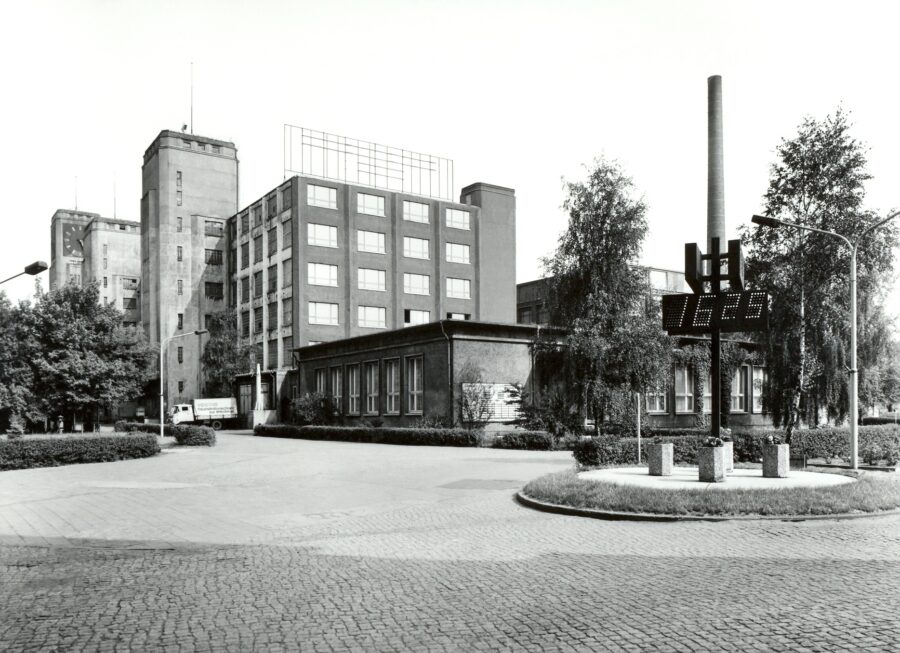
One of the most recognizable parts of the factory was added in the late 1920s: the clock tower (Uhrenturm). Its construction began in 1928, and it was completed in 1929 after fourteen months of work. The project was by the Hamburg architect Felix Ascher.
The tower was built as part of an intended expansion of the factory that was never completed. It was planned to serve as a staircase tower for the enlarged complex, while also incorporating a water reservoir. The reservoir remains part of the tower’s function today, providing an independent supply of drinking and firefighting water to the site.
The tower quickly became a landmark of Wittenberge. Today it is probably the most visible surviving reminder of the Singer factory, and it now houses an exhibition telling the story of both Singer and Veritas companies.
Just after the clock tower was completed, came the worldwide economic crisis of the early 1930s, which also affected Wittenberge. From 1931, the factory reduced the working week from 48 to 40 hours. Production continued but, while in the same year more than 43000 sewing machines were exported, according to Uwe’s research, 138000 unsold machines were also reported There were also strikes in 1932, reflecting the difficult economic and social conditions of the period.
The situation eventually improved, and in 1936 a factory extension was completed. The factory was also adopting increasingly modern production and administrative methods. Among the changes was the use of Hollerith punch-card equipment for production management, another reminder that the Wittenberge plant was a large and increasingly sophisticated industrial operation.

World War II brought a much more dramatic change. From around 1939–1940, sewing-machine production was increasingly restricted as Singer’s Wittenberge factory was converted to military production. By 1944–45, production had shifted entirely to armaments.
At the end of the war, Wittenberge was occupied by Soviet troops. At the end of 1945, the Soviet Military Administration issued an order to restart the foundry in order to produce urgently needed consumer goods, such as plows, stoves, pumps… The factory needed a new name, because all these products could not be sold under “Singer AG”, so in 1947 the foundry and machine factory became the state-owned “Industrie-Werk Wittenberge”.
This effectively brought the Singer chapter of Wittenberge to an end. While the history of its former factory in Wittemberge progressed under new lead, Singer did not leave Germany. After moving its headquarters to Frankfurt in 1949, it eventually opened a new plant in Karlsruhe. The former Singer factory in Wittenberge was eventually re-equipped under the new East German state, becoming the VEB Nähmaschinenwerk Wittenberge and part of the state-controlled textile machinery industry.
The first postwar production was limited, but household sewing machines were added from 1951 and production gradually expanded. In 1955 the factory took over the VERITAS trademark, a name with an earlier history in the German sewing-machine industry.
Further expansions and reorganizations followed, and by the 1960s Wittenberge had become part of the VEB Kombinat TEXTIMA. In 1968, the factory reached one million exported household sewing machines, and in the 1970s further expansion led to the construction of another production facility in Wittenberge.
By the 1980s, the factory employed around 3200 people. Its output included hundreds of thousands of household sewing machines a year. The city itself describes the VERITAS factory during the DDR period as the world’s most modern sewing-machine factory. In 1989, the factory produced its seven-millionth household sewing machine.
With the German reunification, the markets on which the East German factory had depended largely disappeared, while the transition to a new currency and a new economic system created additional difficulties. The factory could not find a buyer and was eventually liquidated by the Treuhandanstalt on 31st January 1992.
The former factory complex has since been transformed into a business park, while the historic clock tower (now open to the public) remains as a landmark of Wittenberge.
Find out info about your machine
If you happen to own a Singer sewing machine, feel free to get in touch and share your machine’s serial number and photos. We’ll help you date and identify it, and add another piece to the Wittenberge puzzle. Thank you for helping us in this monumental research.
Decals from the Wittenberge-made sewing machines
Here are the decal sets recorded on machines made in the factory of Wittenberge, with their periods of use and the classes (models) they were applied to.
It’s a cross-reference of known Singer decal sets with the serial numbers in our own database. This may be helpful to date machines when serial records are incomplete.
Use recorded from 1884 to 1955
While most of the industrial models did not have decals, this one is probably the most common one used on industrial Singer machines. Variations depend largely on the shape of the specific machine. It may feature intricate leaf scrolls or just the ornate monogram "The S.M. Co." ("The Singer Manufacturing Company"). Also the position of each decorative element varies from model to model, due to the particular shapes of certain industrial machines.
Documented machines in this factory
(What does it mean?)Total documented machines: 3
Documented Classes:
- 103

Use recorded from 1921 to 1955
This decal is sometimes called also "Triplets". Commonly used on 15-class machines. We recorded also a couple 66-class with these decals, but it could be a later application of decals on an older machine. Those 66 models were manufactured two decades before the patent for the Trefoil decals was filed. We also recorded a few 24-18 machine with Eye and Trefoils decal, produced before the 1931 patent for this decoration was files. It's indeed possible the patent was filed after the set had been used in production batches. Notice that the patents, while not mentioning specific models, seem to picture class 15 machines or similar.
Documented machines in this factory
(What does it mean?)Total documented machines: 8
Documented Classes:
- 15
Documented years: 1936

Use recorded from 1911 to 1952
The common name of this decal set comes from its fine, lace-like metallic scrollwork designs. It's commonly found on models 66 and 99, but we could also verify a few 15-class machines with those decals, from the factory of Wittemberge (Germany) in particular.
Documented machines in this factory
(What does it mean?)Total documented machines: 11
Documented Classes:
- 15
- 66
Documented years: 1928
Use recorded from 1902 to 1935
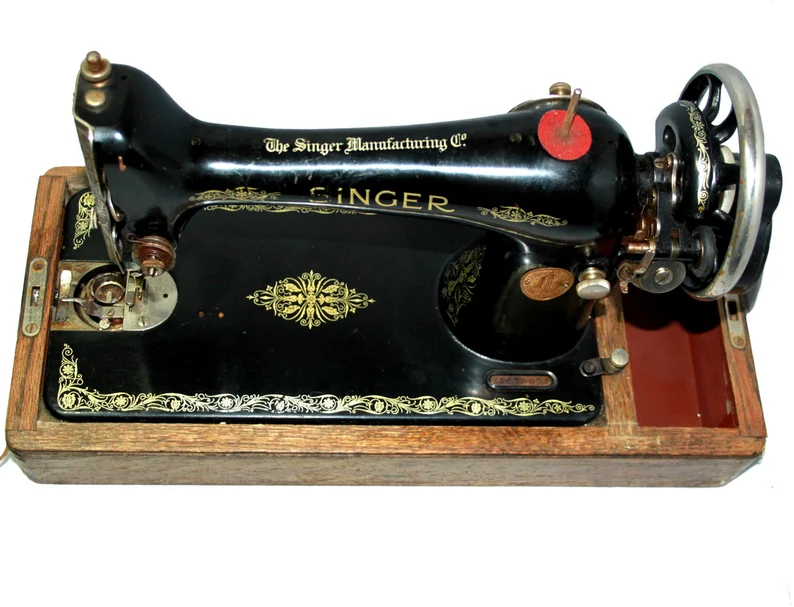
This decal set has ornamental gold flower patterns featuring scrollwork, red accents and an Egyptian-inspired design. Intricate, stylized lotus flower artwork is arranged in symmetrical layouts across the bed and pillar. Small pops of red coloring highlighting parts of the flowers and borders. The application for the patent filed by Robert Whyte in 1903 speaks about "comprises a set of several separate and disconnected parts or figures, all representing conventionally in the same general style the Egyptian lotus flower in various stages of development". This patent was filed in the USA, by a designer from Scotland. It's usually found on 66K machines made in Kilbowie (Scotland, UK), but also documented on 66 machines made in Elizabethport (NJ, USA).
Documented machines in this factory
(What does it mean?)Total documented machines: 1
Documented Classes:
- 66

Use recorded from 1934 to 1956
This decal set was also commonly used on refurbished machines of any model, even applied to models that were out of production before the decals were even designed. The bed edge transfers were cut to length to fit variously sized beds.
Documented machines in this factory
(What does it mean?)Total documented machines: 4
Documented Classes:
- 201

Use recorded from 1887 to 1930
This design is known as Tiffany or Gingerbread. There are two known variants of the Tiffany decal: what changes is the design under the logo metal badge. The earlier style has a triangle-shaped design under the logo badge; the more recent style has a "bird's nest" design below the logo badge, with such badge resting inside the "nest" or slightly raised higher up. No information about when the style changed.
Documented machines in this factory
(What does it mean?)Total documented machines: 8
Documented Classes:
- 15
- 66
Documented years: 1904

Find out info about your machine
If you happen to own a Singer sewing machine, feel free to get in touch and share your machine’s serial number and photos. We’ll help you date and identify it, and add another piece to the Wittenberge puzzle. Thank you for helping us in this monumental research.
Classes from the Wittenberge-made sewing machines
Here are the classes recorded on machines made in the factory of Wittenberge, with their periods of use and the decals applied. The class is the core mechanism design (the base machine type), while the full model number combines that class with a factory code and a sub-version variant indicating specific features. For example, a model 15K88 is sub-version 88 of class 15, while “K” is the factory location code for Kilbowie.
It’s a cross-reference of the classes we associated to serial numbers in our own database. This may be helpful to date machines when serial records are incomplete.
15
Use recorded from 1879 to 1963
Successor to the "New Family", was the "Improved Family", which was given the class 15 designation. Originally patented by Singer engineer P. Diehl in 1878 (UK patent 2813, 13th July 1878), the 'Improved Family' was launched in 1879 as a treadle machine, lock stitch oscillating shuttle. It has the tension on the face plate. By the 1890s the name 'Improved Family' had been dropped and replaced by "Class 15". In the same period, the had received a serious upgrade. It had the most common domestic variant and also several industrial variants.
Documented machines in this factory
(What does it mean?)Total documented machines: 22
Documented Decals:
Documented years: 1904 - 1936

29
Use recorded from 1877 to 1964
Universal feed arm for leather stitching. A range of machines commonly used by shoemakers and leatherworkers for their versatility, in particular for repairing boots and shoes. Many shoemakers use them still today. There is no under-feed, but the machine has a simple and effective top-feed mechanism, which is arranged to carry the work in any direction the operator needs. The progenitor of the class 29 was the U.F.A., "Universal Feed Arm"
Documented machines in this factory
(What does it mean?)Total documented machines: 1
Documented years: 1936

66
Use recorded from 1899 to 1956
Heavy duty domestic sewing machines, low shank and oscillating hook. Full sized machines, while the Class 99 is 3/4 sized.
Documented machines in this factory
(What does it mean?)Total documented machines: 9
Documented Decals:
Documented years: 1928
96
Use recorded from 1911 to 1959
Industrial rotating hook machines. Longer version of Class 95.
Documented machines in this factory
(What does it mean?)Total documented machines: 1

103
Use recorded from 1912 to 1958
Industrial high speed lock stitch machines, with rotating hook, fitted for for electric or foot power.
Documented machines in this factory
(What does it mean?)Total documented machines: 7
Documented Decals:

201
Use recorded from 1932 to 1961
Domestic horizontal rotary hook machines.
Documented machines in this factory
(What does it mean?)Total documented machines: 4
Documented Decals:

206
Use recorded from 1934 to 1953
Domestic zig-zag machines with vertical rotary hook.
Documented machines in this factory
(What does it mean?)Total documented machines: 13
Documented years: 1936 - 1940

207D
Swing-needle zig-zag lockstitch machines, produced only in the factory of Wittenberge (Germany). Heavier than the 206D, this class featurs a larger bed and greater clearance for heavy fabrics, canvas, and light leather.
Documented machines in this factory
(What does it mean?)Total documented machines: 2

Find out info about your machine
If you happen to own a Singer sewing machine, feel free to get in touch and share your machine’s serial number and photos. We’ll help you date and identify it, and add another piece to the Wittenberge puzzle. Thank you for helping us in this monumental research.
Resources
- The history of Singer Wittenberge factory, from SingerSewingInfo.co.uk
- The history of the Wittenberge factory, from ISMACS
- The Singer factory of Wittenberge, from Wikipedia (in German)
- The abandoned factory
- Singer in Germany, from Fiddlebase
- Wittenberge Museum collection (in German)
- Wittenberge clock tower (in German)
- On the history of Singer company
- Complete database of vintage Singer sewing machines serial numbers, plus info about serial numbers, factories and location codes, class and model numbers
- Singer sewing machine manuals
- Singer sewing machine decal sets